The Jötnar: Exploring the Chaotic Kin of Norse Mythology

Introduction
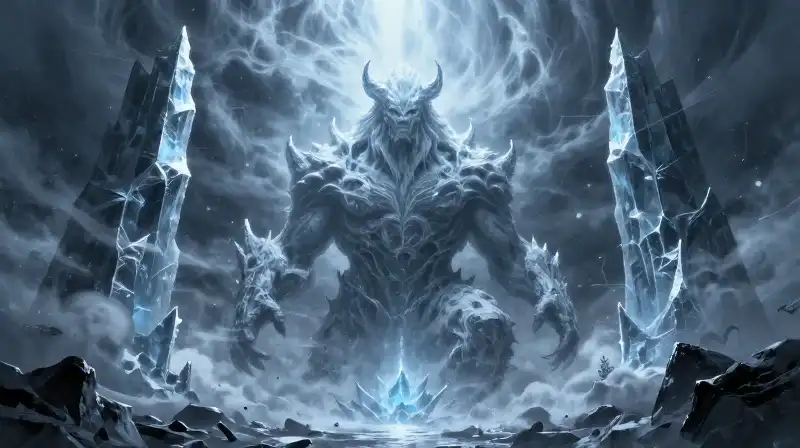
When the term “giant” is used to describe the Jötnar in Old Norse tradition, the translation often misses a profound semantic depth and cultural context. The Jötnar are far more than simply large, monstrous beings; they represent a fundamental part of the mythological landscape—a dynamic kin group defined by their relationship to the gods and the primal forces of nature. To understand the Jötnar is to understand the vast and often terrifying ecology of the cosmos they inhabit.
In the Norse tradition, the Jötnar constitute a primal, chaotic force. Cosmologically, they are tied to Utangard, the world lying beyond the boundary of civilization or the divine enclosure of Innangard 1. They represent the anarchic energies of creation itself, constantly testing the established order maintained by the Æsir and Vanir. While frequently depicted as antagonists who challenge the authority of the gods, the tradition reveals a much richer, more complex picture of this group than the common portrayal suggests.
The Kinship of Chaos: Origins and Cosmological Place
The origins of the Jötnar are rooted in the very birth of the cosmos. According to the traditions preserved in the Old Norse Eddic corpus, the first giant, Ymir, was formed from the rime of Niflheim, and all other Jötnar descended from him 1. This lineage grounds them in a state of primordial chaos.
Crucially, scholarly examination suggests that the word itself, *jötunn*, may have a broader meaning, potentially linking it to the Proto-Germanic concept of “devourer” (2; 1). However, the functional role of the Jötnar was not always merely antagonistic. In many instances, they are described not by their size, but by their kinship and their connection to the immense, unforgiving elements. This is why some interpret them as powerful personifications of natural phenomena—such as the sea, the wind, or the frost—and not uniformly as beings motivated purely by malevolence (3; 2).
Their existence serves a vital function in the narrative cycle: they are the forces of entropy, the natural limits to civilization. While the gods represent order and the constructed world, the Jötnar embody the raw, untamed power of nature and the chaos that surrounds it (3; 2).
A Complex Tapestry: Deconstructing the ‘Monster’ Label
The modern popular image of the Jötnar is often confined to a picture of brute, unintelligent, and eternally hostile monsters. Yet, the source material reveals a significantly more nuanced and dynamic portrayal. The idea that all Jötnar are mortal enemies of the gods is not accurate 1.
For instance, powerful individuals who were originally part of the Jötnar kin—such as Skadi, Loki, and Thor’s mother—later became integrated into the pantheon’s ranks, demonstrating that belonging and evolution are possible within the tradition 1. Furthermore, their physical appearance is often variable. While some are depicted as physically imposing or monstrous, the traditions also describe certain Jötnar as beautiful 1. This duality—of terrifying power combined with varying degrees of aesthetic or intellectual depth—underscores their complexity.
Additionally, the concept of Jötnar was not static. The introduction of Christian influence began a process by which the Jötnar were progressively “demonized,” leading to a cultural shift toward portraying them as less intelligent and more purely monstrous over time (1; 3). This is an important lens through which to view the evolving interpretation of the folklore rather than assuming an unchanging ancient view.
Beyond the Giants: Semantic Range and Cultural Practice
To fully grasp the diversity of the Jötnar, it is necessary to look at the regional and specific terminology used in Old Norse literature. Scholars identify specific variations that provide greater clarity than the sweeping translation of “giant”:
- Tröll: This term holds a wider semantic scope than merely a giant. In Old Norse literature, *tröll* encompasses a broad range of supernatural figures, including witches, ghosts, and even berserkers (1; 3).
- Specific Terminology: Other terms like þurs (referring to a “powerful and injurious one”) or gýgr (designating female Jötnar) were used to categorize members of this kin group with regional specificity (1; 3; 2).
In terms of cultural practice, journeying to the realm of the Jötnar often held symbolic significance. Within the Old Norse narrative, such travel frequently serves as a ritual meant to acquire deep, secret knowledge—be it lineage secrets or the Mead of Poetry 1. This suggests that despite their association with chaotic forces, the Jötnar realm is also a place of profound, albeit difficult, insight.
Where Tradition Meets Search: Addressing Specific Questions
As interest in Norse mythology grows, specific questions regarding the tradition arise, sometimes blurring the lines between the mythological and other cultural contexts. One query asks who killed the Jötnar. In the grand narrative of Ragnarök, the gods and the Jötnar are destined to engage in a final, cosmic conflict, but the Jötnar do not simply vanish; they are central to the end and rebirth of the cycle itself.
Another related search often asks what the Vikings called Jesus. It is important to note that the cultural and spiritual frameworks of the Germanic peoples—including the specific terminology surrounding the Jötnar—are rooted in the pre-Christian and early medieval Scandinavian world. The transition to Christianity significantly altered how these mythic figures were interpreted and subsequently integrated into the cultural consciousness of the time (1; 3).
The Ecological and Narrative Significance of the Chaotic Kin
Despite the tendency to view the Jötnar as purely antagonistic, some folkloric interpretations suggest that they perform an essential ecological role. Civilization, with its laws and defined boundaries, relies on resources and processes found within the wild, chaotic realms that the Jötnar inhabit 1. The Jötnar are, in a sense, the custodians of the wildness—the necessary contrast to the cultivated order.
To understand the Jötnar is to grasp the Norse appreciation for duality: the fact that one cannot define the “civilized” without the “wild,” nor can one understand the limits of order without the power of chaos. They are not merely villains; they are a necessary part of a complex mythological ecosystem, reflecting the dynamic and often unpredictable forces of nature that exist alongside human creation.
References
Footnotes
Frequently Asked Questions
What did the Vikings call Jesus?
The article does not specify what the Vikings called Jesus, but it notes that the transition to Christianity significantly altered how cultural and spiritual frameworks were interpreted in the Scandinavian world.
Who killed the Jötnar?
In the grand narrative of Ragnarök, the gods and the Jötnar are destined to engage in a final, cosmic conflict. However, the Jötnar do not simply vanish, as they are central to the end and rebirth of the cycle itself.
Related Articles