Ihy: The Egyptian God of Joy, Music, and Fertility

Introduction
In the rich tapestry of ancient Egyptian belief, gods often possess clear, singular identities—a hunter, a healer, a celestial father. Yet, sometimes the most profound figures are defined by a vibrant, almost chaotic energy: the joy of childhood, the resonance of sacred sound, and the promise of cyclical renewal. Such a figure is Ihy, a youthful deity who did not merely represent a trait but embodied the living, rhythmic pulse of life itself. Ihy is a playful, vibrant god of joy and music, deeply intertwined with the powerful maternal energies of Hathor.
To study Ihy is to look beyond standard pantheon entries; it is to understand how community and culture harness the power of celebration. He is the embodiment of the ecstatic—a deity linked to both the sensual pleasures of life and the profound mysteries of the afterlife, demonstrating a complex dual role that fascinated the people who worshipped him. His presence transformed the religious landscape of the temple, adding a layer of maternal warmth and protective merriment to the grand, powerful deities surrounding him.
The Sacred Language of the Sistrum
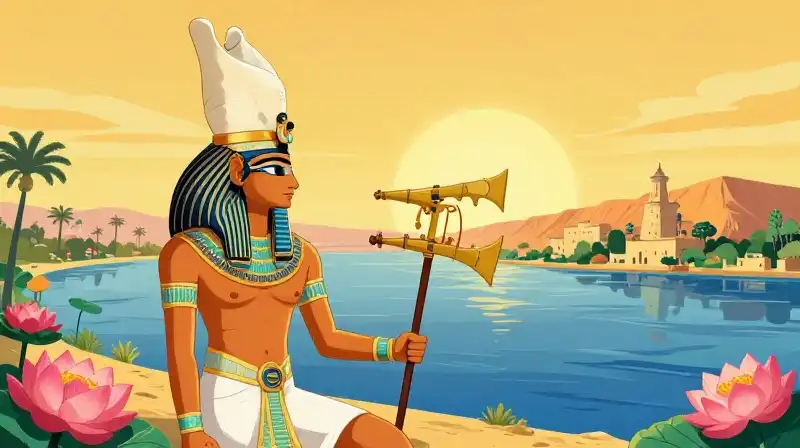
At the heart of Ihy’s cultural significance lies the sistrum, a sacred rattle fashioned from brass or bronze. This instrument was not merely a musical toy; it was a powerful ritual implement, especially revered in the worship dedicated to Hathor. By wielding the sistrum, Ihy represents the vibrant sounds of creation and sustenance (1, 3). The sound it produces was understood to have a protective, almost vibrational quality—a sound that could push away malign forces and guard worshippers against negative energies 1.
Ihy’s connection to the sistrum links him directly to themes of fertility and life-giving power. While his playful nature might suggest simplicity, his association with the instrument places him firmly within a tradition of sacred performance. This cultural practice suggests that rhythm and sound were considered fundamental tools for maintaining cosmic order. He was seen as more than a whimsical child; he was a divine mechanism for generating positive energy and promoting well-being 1.
The Layers of Meaning: From Calf to Musician
The identity of Ihy presents scholars with layers of intriguing ambiguity. The specific meaning behind the name “Ihy” itself remains a subject of debate (2, 3). Possibilities range from a simple descriptor, meaning “calf,” to a more sophisticated designation, “musician” or “sistrum player” (2, 3). This ambiguity mirrors the multifaceted nature of the deity himself, who operates across multiple cultural registers.
Beyond his role in the temple of Dendera, there is a fascinating regional connection in Upper Egypt. In that context, the word “Ihy,” or calf, was used in a practical, pastoral setting to guide cattle across a river 1. This suggests that the deity’s identity was not purely abstract; it was deeply rooted in the practical, daily realities of the Egyptian community, particularly those connected to pastoral life. This blending of the sacred and the practical is a hallmark of many regional traditions within the broader Egyptian cultural sphere.
Iconography and Lineage: Mapping the Divine Family
Culturally, Ihy is recognizable through specific visual identifiers. He is typically depicted as a naked child, embodying unrefined, vital innocence. His adornments—the menat necklace and the Pshent crown—place him firmly within the recognized family of deities (2, 3). Iconographically, he is often shown holding his sistrum or even posing with a finger in his mouth, reinforcing his playful, mischievous nature (2, 3).
While his iconography is clear, his divine lineage is equally complex and subject to various traditions. The most popular scholarly view places him as the child of the cosmic god Ra and the great goddess Hathor (1, 2). However, other traditions propose connections to powerful goddesses and gods like Horus, Isis, Sekhmet, or Neith (1, 2). This diverse family tree suggests that Ihy’s appeal spanned various generations and required different theological explanations depending on the local emphasis of a particular community.
The Healing Power: Ihy’s Dual Role in Life and Afterlife
What sets Ihy apart from many other youth deities is his astonishing versatility. He was revered for his youthful exuberance and pleasure—associated with sensual lust and fertility—but he also played a role in the realm of funerary practices (2, 1). This duality is reflected in his appearance in important religious texts, including the Coffin Texts and the Book of the Dead (1, 3).
This capacity for duality is a powerful cultural insight. Ihy’s presence demonstrates that vitality, play, and death were not seen as separate concepts, but as interconnected phases of existence. His journey allowed him to bridge the joyful moment of life with the necessary passage into the next realm. Furthermore, the widespread veneration of Ihy contributed to a significant shift in how Hathor was perceived within the faith, helping to transform her image from a potentially vengeful force into a symbol of a loving, nurturing mother 1.
Beyond the Temples: Why Ihy Matters to Tradition
Ihy’s tradition offers a valuable lesson for understanding the fluidity of ancient belief systems. He was not a static figure. His worship helped define how sound functions in ritual and how the innocent aspects of childhood could be elevated to the divine. Whether depicted alongside Horus and Hathor in the grand halls of the Dendera temple or acknowledged in the subtle daily life of a shepherd, Ihy’s spirit is consistently one of vibrant, protected joy.
The tradition of Ihy reminds us that heritage is not just found in grand myths; it is in the rituals, the sounds, the local interpretations, and the shared cultural values that shape a community. He stands as a powerful testament to how the simple, beautiful rhythms of life and the profound need for protection can coalesce into the image of a divine child.
References
Footnotes
Related Articles