Who is Heh? The Ancient Egyptian God of Eternity and Infinity

Introduction
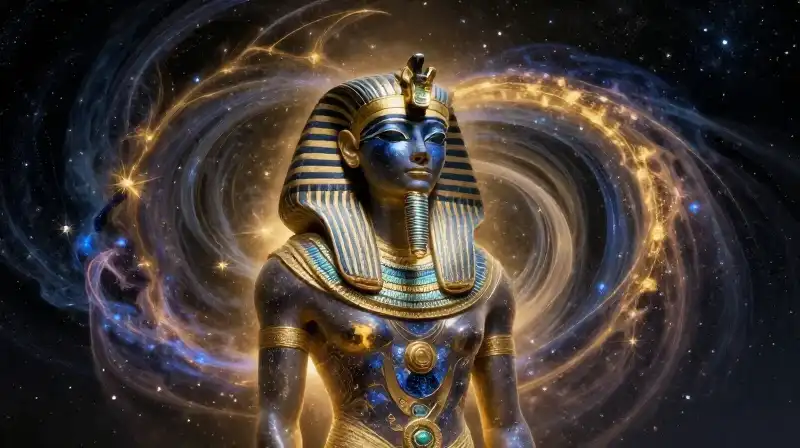
To speak of Heh is to speak of time itself, not as a sequence of moments, but as an unbounded, eternal existence. In the ancient Egyptian spiritual landscape, Heh is far more than a deity; he is a powerful, personified concept—the concept of infinity. This primordial figure, alongside his consort Hauhet or Hehet, stands at the heart of the Ogdoad, the group of eight primeval deities who represented the foundational chaos and creative force of Hermopolis Magna [1, 2]. To understand Heh is to grasp how Ancient Egyptians approached the infinite, linking abstract cosmic cycles to tangible symbols, hieroglyphs, and the very quest for longevity within the Egyptian belief system.
The Ogdoad and the Nature of Primeval Chaos
Heh and Hauhet originated in the mythos of creation, embodying the concept of limitless, watery chaos known as Nu, the state that preceded the formation of the finite world [1, 2]. They represent the infinite potential from which all existence arose. The deity’s name itself holds a profound linguistic link to this abstract concept, as it originally signified either “flood” or “million” [1, 2]. This connection is essential: the Egyptians used a measurable quantity—one million—to anchor the concept of the immeasurable, eternal past.
The Ogdoad as a whole represents a stable, foundational framework for their understanding of the universe, but Heh specifically represents the watery, infinite nature of existence before order was imposed. According to mythological accounts, these figures were central to creation, emerging from the primal “egg” to give life to the God of light, Re [2]. This places Heh at the absolute beginning of time and space in their cosmology.
Iconography: Measuring the Infinite
Because Heh represents something boundless, his visual representations had to be incredibly dense with symbolic meaning, transforming the abstract concept into a powerful, ritualistic image. The deity was typically depicted in two primary forms, reflecting his gendered duality: Heh appeared either as a human-headed figure or, frequently, as a frog [1, 2]. His consort, Hauhet or Hehet, took on a serpentine or snake-headed appearance [1, 2].
The objects held by Heh served as symbolic shorthand for his powers and the nature of his eternity:
-
Notched Palm Branches: These were a crucial element of his iconography, symbolizing long life and immortality. The notches on the branches were interpreted as years of this eternal existence.
-
The Shen Ring: Positioned at the base of his symbols, the shen ring was a potent Egyptian sign, specifically representing the number one million. In Egyptian numerology, the hieroglyph for Heh was utilized to represent 1,000,000, which the culture equated with eternity [1, 2].
This confluence of the palm branch (life) and the shen ring (one million) is how the Egyptians visually expressed the concept of endless life tied to cosmic duration.
The Dual Time: Neheh and Djet
Beyond the simple concept of endless duration, Heh embodies two complementary ideas of time that define the rhythm of the Egyptian universe. 2 explains these as “neheh” and “djet,” a sophisticated duality that governed everything from the seasons to the afterlife.
-
Neheh: This is understood as ‘active infinity.’ It is associated with the sun and the cyclical, measured passage of time—the daily movement of the sun, the constant rebirth of the cycle. It represents dynamic, moving time.
-
Djet: This represents ‘passive eternity.’ It is associated with the static, timeless aspects of the night and the unchanging nature of the primordial chaos. It is the eternal, unchanging state.
Together, these two concepts ensure that time is not merely a line, but a continuous, self-renewing circle, bridging the infinite chaos of creation with the measured cycles of existence. The figure of Heh was also connected to the god Shu, suggesting a role as a deity of the air and wind, a force necessary to support the stability of the sky [2].
Kingship, Longevity, and Living Practice
The concepts embodied by Heh resonated deeply with the human desires for permanence and success. His association with “millions of years” made him a potent symbol of stability and eternal rule. Heh frequently appeared on monuments and funerary objects—such as those found in the tomb of King Tutankhamun—to grant the ruler a claim to endless life in the afterlife [1, 2]. He became a protective force ensuring the king’s reign was as vast and enduring as the concept of infinity.
Crucially, unlike some major Egyptian deities who possessed grand, central sanctuaries, the worship of Heh was highly symbolic and internalized [1]. His power resided primarily in his visual representation—the notched palm ribs—which functioned as a ceremonial tool for marking the passage of cycles within the temple. This meant the tradition lived powerfully in amulets, personal charms, and in the symbolic language of stone and gold, rather than solely through centralized temple ritual.
The Enduring Symbol of Time
Ultimately, the figure of Heh stands as a monumental example of how ancient cultures grapple with the truly infinite. He represents the bridge between the abstract and the measurable: taking the boundless nature of primordial water (Nu) and framing it within the Egyptian system of counting (one million). Whether he is depicted as the frog, the snake, or the symbol of the shen ring, Heh remains the constant link to eternity—a divine reminder that time, in the Egyptian view, is a continuous, self-renewed cycle of limitless potential, rather than a finite track.
References
Footnotes
Frequently Asked Questions
What is heh the god of?
Heh is the personified concept of infinity and time, embodying the limitless, watery chaos known as Nu. He is associated with eternal existence, stability, and the nature of the air and wind.
Related Articles