Set: Egypts God of Storms, Chaos, and the Desert

Introduction
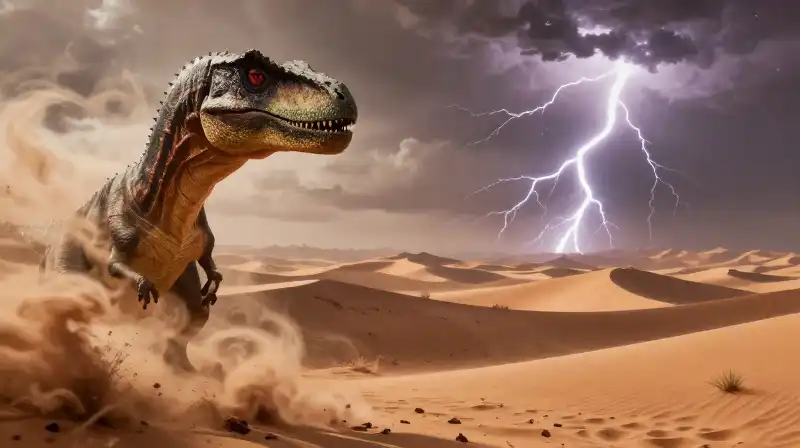
To understand the complex religious landscape of ancient Egypt is to accept that stability and chaos were not opposing forces, but co-dependent parts of the same cosmic fabric. Set—or Seth in the Western tradition—is perhaps the most potent embodiment of this paradox. He was fundamentally viewed as a god representing disorder, deserts, and storms 1. Far from being merely a villain in a mythological story, Set’s existence was a necessary creative element within the ordered world of Egyptian civilization 1. His role placed him among the principal deities of the cosmos as a master of storms and sky god 1. For the reader seeking to understand this tradition, Set is not just a character from a myth; he is a cultural concept that helped define the relationship between humanity, the wild elements, and the state-sanction order of the Nile Valley.
The Cultural Logic of Balance: Horus vs. Set
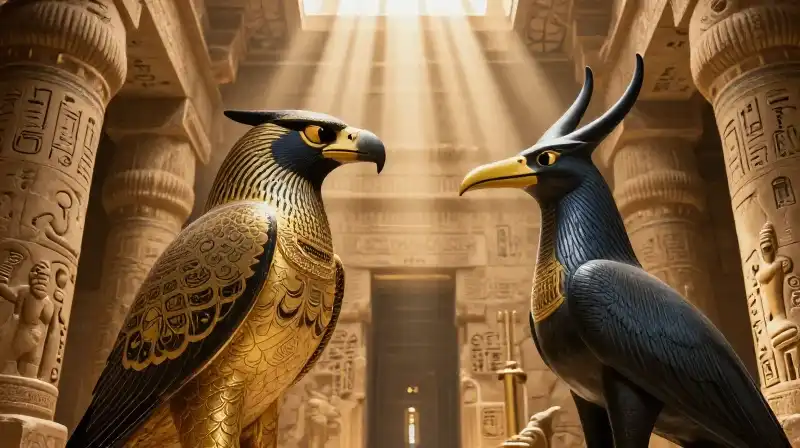
The primary cultural context for Set can be found in his relationship with Horus. While Horus was the lord of the fertile Black Land—the life-giving, ordered Nile environment—Set represented the lord of the Red Land, which was the desert and the volatile, untamed edges of the known world 1. This dynamic established the “vital balance” between the two 1. Set represented dangerous violence and creative chaos 1, a dual nature that reflected the Egyptian understanding of a world that could only exist because it acknowledged forces beyond human control. His original cult flourished in Upper Egypt, specifically at the site of Nubt near modern-day Ṭūkh, located on the western bank of the Nile 1.
His cultural importance crystallized through his participation in the foundational struggle for the kingship of Egypt. His role in usurping and murdering his brother, Osiris, initiated a major cultural conflict—known as “The Contending of Horus and Seth” (1, 2). This conflict was often depicted not merely as a bloody battle, but as a legal and spiritual judgment presided over by the entire assembly of gods, lending the struggle a profound political and cosmic weight 1.
A Fluid Image: How the Divine Perception Shifted
The perception of Set was highly volatile, shifting according to the political and spiritual priorities of the eras in which he was worshipped. Set’s physical representation was remarkably variable, appearing as a man with a donkey’s head, an enigmatic “Set animal,” or simply a donkey (1, 2). However, it was his role and status that underwent the most dramatic evolution.
Initially, his identity was strongly linked to storm deities. During the Hyksos invasion, Set’s cult even evolved to a point where he was identified with the Canaanite storm god Baal 1. In the New Kingdom, the Ramesside pharaoh actively encouraged a shift in how Set was viewed. He was promoted to the image of a powerful martial god and a fierce protector of Re (the sun god), ranking him among the great, powerful entities of the Egyptian pantheon 1. This transformation from a chaotic force to a martial protector speaks volumes about the cyclical need of a civilization to re-contextualize its divine powers during times of upheaval.
The Enduring Mystery of the “Set Animal”
For many modern researchers, the most intriguing aspect of the Set tradition remains the identity of his symbolic animal. Scholars describe the “Set animal” as enigmatic, meaning it was deliberately obscure, likely representing an inherent quality of chaos or untamed nature (1, 2). Hypotheses regarding its exact nature are broad, suggesting a range of possibilities, from the domesticated Saluki to the wild giraffe or the common donkey 1. Regardless of its precise form, the animal served to anchor his chaotic energies in the physical world. It allowed him to be visually present, embodying the “Red Land” on the periphery of civilization, thus embodying the boundary between the known and the wild.
The Cycle of Neglect and Reinterpretation
Like many deities in a vast pantheon, Set’s prominence followed the prevailing theological trends. As the cult of Osiris gained increasing power and spiritual centrality, Set was gradually sidelined 1. The tradition of his worship eventually diminished, leading to the deliberate effacing of his image from sacred monuments 1. This religious effacement was not simply a disappearance but a transformation of his cultural meaning.
In post-unification history, and in later Hellenistic thought, Set’s reputation took on a purely antagonistic tone. He was no longer reconciled with Horus; instead, he was often equated with figures of pure, unbridled destruction—such as the Egyptian demon Apopis or the Greek primordial terror, Typhon 1. This represents a shift from an ancient concept of necessary duality to a later, more singular concept of threat.
Why Does Set Matter in Ancient Egyptian Culture?
To answer the question of his ultimate significance: Set’s role served a profound cultural function. He allowed the Egyptian community to acknowledge the untamed elements of existence—the dangerous storms, the vast desert, and the unpredictable changes of life—without having to suppress them. His narrative was a constant reminder that order (Horus, the Nile) required a dynamic counterpoint in chaos (Set, the Desert) to remain truly complete. He was the necessary boundary, the embodied risk, ensuring that the stability of the kingdom was always understood in the context of cosmic power and wild uncertainty.
The study of Set, therefore, is not merely an academic exercise in mythological classification. It is an invitation to understand a worldview that embraced the complexity of duality. He taught the Egyptians that the world is not a perfected garden, but a living, breathing entity that demands respect for both its peace and its storms.
References
Footnotes
Frequently Asked Questions
Is there an Egyptian god of storms?
Yes, the article identifies Set as a god who represented disorder, deserts, and storms, specifically referring to him as a master of storms and sky god. Initially, his identity was strongly linked to storm deities.
Who is the Egyptian storm god?
Set (or Seth) was fundamentally viewed as a god representing disorder, deserts, and storms, and his role placed him among the principal deities as a master of storms and sky god. Furthermore, his identity was initially strongly linked to storm deities, and during the Hyksos invasion, his cult was identified with the Canaanite storm god Baal.
Related Articles