The Dagda God: Exploring the Multifaceted Deity of Irish Mythology

Introduction
The figure of the Dagda stands at the heart of Irish mythology as a deity of immense complexity—a figure who is simultaneously a king, a father, a warrior, and a sorcerer. He is the chief god of the Tuatha Dé Danann, a lineage of supernatural beings deeply embedded in the ancient landscape of Ireland (1, 2). Unlike deities in some traditions who might be confined to a single domain, The Dagda represents a breadth of influence, encompassing both the fertile earth and the forces of cosmic change 1. To understand the Dagda is not merely to catalog powers; it is to explore the foundational relationship between ancient people and the cycles of nature, labor, and the sacred borders of their land.
The Master of Cycles and Provision
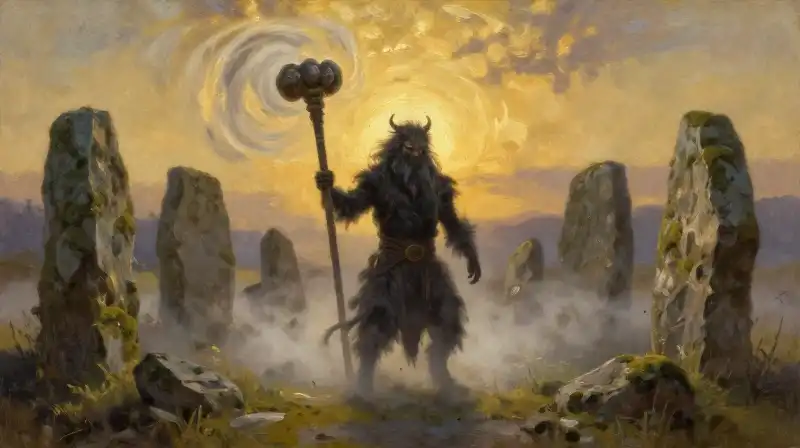
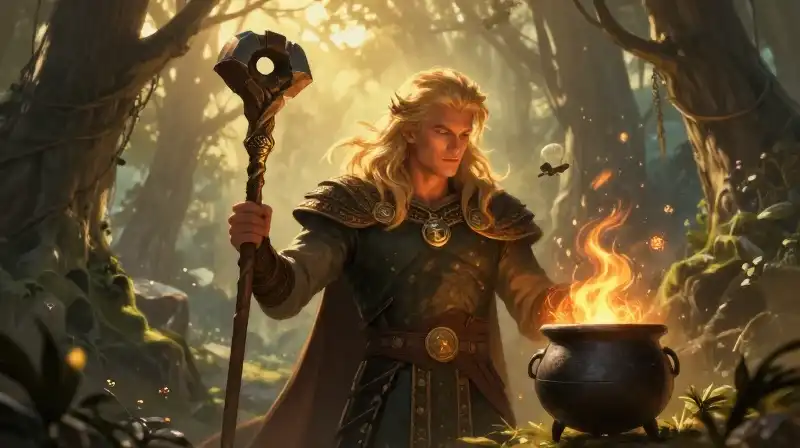
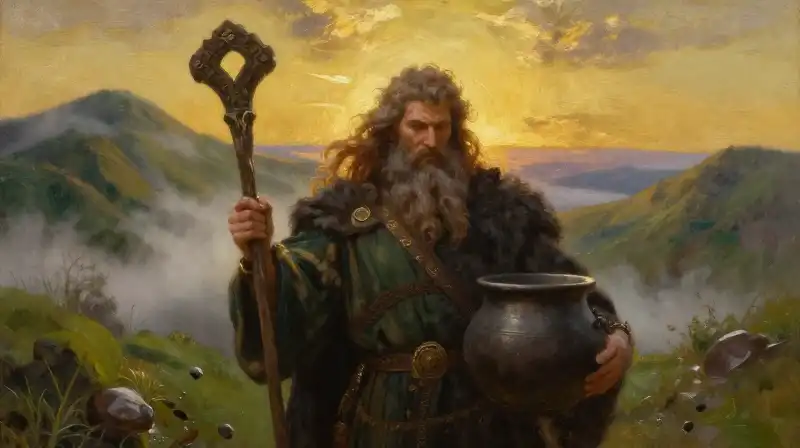
The Dagda is fundamentally tied to the life-giving rhythms of the natural world. He holds dominion over agricultural fertility and the transition between life and death, controlling crops, the changing seasons, and the fundamental forces that govern existence (1, 2). This connection to provision is physically embodied in his most iconic attribute: the *coire ansic*, or the “un-dry cauldron” (1, 2). This vessel was not just a pot, but a symbol of infinite abundance and generosity, positioning the Dagda as a giver of gifts to both the people and the land. His capacity for both creation and destruction is perfectly encapsulated in his powerful magic staff. One end of the staff is described as a conduit of life, capable of bringing abundance, while the other holds the power to cause instantaneous death (1, 2). This duality suggests that he is a force of cosmic order, capable of balancing the harsh realities of the natural world—a figure of great power who understands both the blessing and the burden of existence.
The Architect of Sacred Order
Beyond his status as a provision-giver, the Dagda is intimately connected to the maintenance of cosmic structure. His magic harp, *Daur Dá Bláo*, is described in legends as possessing the power to set the seasons into their proper, cyclical order (1, 2). This capacity to manage time and structure links him to the idea of ancient knowledge. His numerous epithets reflect this multifaceted power. For instance, names like *Eochaid Olathair* (“Horse Lord Ample Father”) and *Ruad Ro-fhessa* (“Red man of Knowledge”) illuminate his roles as a potent figure of both domestic power and profound wisdom (1, 2). While often called the “good god” (1, 3, 2), modern scholarship suggests his character may be more complex. 3 notes that he is not necessarily purely benevolent but is instead a highly knowledgeable and formidable figure who might wield his ego or exhibit tendencies akin to a trickster, reflecting the nuanced nature of powerful Celtic deities who possess wide-ranging interests rather than single, limited domains (3, 2).
The Dagda and the Tradition of the Land
For the ancient peoples, the Dagda represented the physical reality of labor and the establishment of civilization. He was depicted as a figure who actively shaped the geography of Ireland, clearing dense forests and digging up lands that served to define the region’s borders 1. This establishes a deep link between the deity and the physical stewardship of the land. Culturally, he embodies the ideals of the powerful king and the wise patriarch, making him a figure deeply relatable to both community leadership and family structures 1. Furthermore, his relationship with other deities, such as the goddess Morrígan and his progeny—including Brigit and Aengus—demonstrates his central position within the mythological kinship of the Tuatha Dé Danann 1.
Clarifying His Roles: Druid, King, or Beyond?
A common query regarding the Dagda is whether he is a druid. While his title “Red man of Knowledge” (1, 2) strongly suggests a mastery of esoteric arts and wisdom, and he is described as a sorcerer, he is generally seen as more than just a practitioner of magic. He is a sovereign entity—a king and a primal force of nature. The Druidic connection is better understood as a reflection of his profound knowledge and mastery over the natural and spiritual sciences, rather than a simple job title. The language used to describe him in literary traditions, specifically ancient poetic structures like the *rosc*, allows his persona to shift, permitting him to appear both as the “talkative or boastful” figure and the intensely perceptive man who sees the world as it is 1. This adaptability underscores the complexity of the character, who functions across multiple domains—governing, teaching, warring, and nurturing.
The Legacy of the Tuatha Dé Danann
In contemporary cultural contexts, the presence of the Dagda and the Tuatha Dé Danann has evolved into a concept of deep ancestral connection. These figures are often understood by modern traditions as “place gods”—entities who are believed to reside within the hills and ancient lands of Ireland 1. This view bridges the gap between mythological stories and a living, geographical relationship with the ancestral past. The Dagda’s continued relevance lies in this idea of embodied heritage: a reverence for the foundational forces and the powerful spirits believed to have shaped the identity of the land. In conclusion, The Dagda is more than a titular god; he is a living symbol of the intricate balance between immense power and profound responsibility. From the dual nature of his magic staff to his role in setting the seasons, he represents the entire spectrum of existence—the bountiful harvest and the swift winter, the wisdom of the ancient lore and the strength of the king. He remains a potent cultural anchor for those who seek to understand the depth of Irish heritage, serving as a reminder that power, in its highest form, is always tied to knowledge and the stewardship of the world.
References
Footnotes
Frequently Asked Questions
Is the Dagda a druid?
The Dagda is generally seen as more than just a practitioner of magic, being viewed as a sovereign king and a primal force of nature. His association with druidic themes is understood as a reflection of his profound knowledge and mastery over the natural and spiritual sciences rather than a simple job title.
Related Articles