Defining Minor Greek Goddesses: Epithets, Roles, and Function

Introduction
The pantheon of Ancient Greece is often dominated by the monumental figures of the Olympians: Zeus, Hera, Poseidon, and Athena. Yet, to truly understand the complexity and lived reality of Greek spirituality, one must look closer, into the rich, often overlooked tapestry of the minor deities. These minor Greek goddesses and their counterparts were not merely footnotes in the grand mythological narrative; they were the localized, practical, and essential spiritual bedrock of countless communities. They represented a profound engagement with the immediate environment—from the subtle shifts in weather to the ephemeral graces of youth and persuasive charm.
Unlike the universally recognizable central figures, the function of a minor goddess often lay in her specific relationship to a human experience or a localized natural phenomenon. This complexity demonstrates a belief system that valued hyper-specific connection over generalized power. As research into Greek folklore continues, scholars recognize that the vast number of deities operating beyond the standard twelve illustrates the deep, textured layers of communal belief across the Greek world 1.
The Language of Specificity: Epithets and Local Power
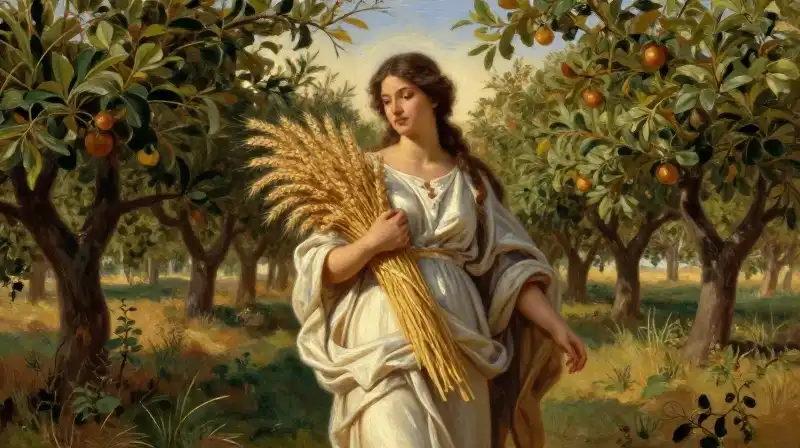
In the Ancient Greek world, a name was often insufficient to define a divine role. This is why the identity of many minor goddesses was frequently tied to an epithet or a title rather than simply her name 1. This practice allowed worshippers to specify precisely which function or aspect of a deity they were invoking. A goddess might be called the ‘Persuasive One’ or the ‘Protector of the Autumn Harvest,’ demonstrating that her power was highly contextual.
This emphasis on epithets reflects the highly localized nature of many of these traditions. While the twelve Olympians provided a pan-Hellenic framework, many minor natural deities were primarily of local importance, practiced regionally across Greece. This meant that what was revered in one village or region might differ significantly from the worship practiced hundreds of miles away 1. These regional variations allowed a community to ground abstract divine forces into concrete, local contexts that resonated with their specific agricultural cycles, social structures, and immediate environmental concerns.
The Functional World: Embodiment of Human and Natural Experience
The minor goddesses served as sophisticated conceptual tools, acting as personifications of specific, often subtle, aspects of life. They were rarely figures of cosmic war; instead, they embodied human and natural experiences. According to 1, these figures often represented concepts such as youth, persuasion, the seasons, and different manifestations of weather.
These figures often held crucial supporting roles within the divine hierarchy. Many functioned as handmaidens or members of the retinue of major deities, reflecting a complex but organized structure within the divine family 1. For instance, figures like Hebe (linked to eternal youth) or Peitho (associated with persuasion) embodied specific human institutions or societal functions 1. These are not simply “side characters” in a grand story, but living spiritual functions that were believed to influence mortal events, from seduction to the successful completion of childbirth 1.
Where the Gods Meet the Ground: Temenē and Sacred Practice
The importance of these localized deities was solidified in their physical place of worship. Cult practice—the way people honored and communicated with the divine—involved specific religious activities like sacrifices, prayers, and libations. These rituals were conducted within designated sacred spaces known as temenē 1. A temenos was not just a temple, but a consecrated precinct set aside for the particular local deity’s care.
For the communities that upheld these traditions, the temples were functional hubs of life. They provided a mechanism for integrating the divine into the rhythm of the daily life, the harvest, and the passage of time. The way the ancient Greeks understood these figures was profoundly shaped by their iconography—the symbols and artistic depictions used to represent them—and the myths surrounding their specific actions 1. This connection between art, myth, and practice allowed the tradition to remain a living cultural presence, even when the gods were not in the center of the global pantheon.
The Depth of Greek Folklore: Nymph, Muse, and the Collective Divine
Examining the minor goddesses requires understanding that they are part of much larger, intricate spiritual groupings. Within the broader spectrum of Greek folklore, minor figures encompassed groups that held distinct cultural value despite their lower rank relative to the major gods 1. These included the Nine Muses, who inspired the arts, the Graces, who personified beauty and charm, and countless nymphs, who were often tied specifically to local geography like springs or groves 1.
The conceptual origins of these figures were diverse, ranging from older, established deities who predated the Olympian period, to more abstract personifications or ‘daimons’ representing philosophical concepts like justice or might 1. This variety highlights the flexibility and adaptive nature of the tradition. Some minor goddesses, such as those linked to Zeus and Demeter, played vital roles in major myths concerning the annual cycle of the seasons, linking the divine directly to the essential rhythms of agriculture and nature 1. It was this deep, layered complexity that fueled dedicated academic research, as scholars strive to archive and understand the vast body of deities that extend far beyond the commonly cited names 1.
The Resonance of Minor Deities in Culture and Community
The significance of the minor Greek goddesses lies in their ability to ground the sublime in the mundane. They provide a lens through which we can view an ancient world that was fundamentally pragmatic, yet deeply spiritual. They were the deities of the ‘in-between’—the transition from summer to fall, the moment of artistic inspiration, the negotiation of a difficult social situation, the promise of a healthy child.
By focusing on epithets and regional function rather than grand, unifying narratives, the tradition reveals a powerful cultural insistence on specificity. The minor deities remind us that the spirit of a culture is not defined only by its greatest heroes, but by the countless small, localized beliefs that dictate how a community manages its daily life, honors its ancestors, and celebrates the small miracles of its world. This deep dive into the periphery of the pantheon is where the truly living culture of the Greeks is found.
References
Footnotes
Frequently Asked Questions
Who is the minor goddess of beauty?
The Graces were the minor figures mentioned in the article who personified beauty and charm. These figures were part of a larger group of minor goddesses within the spectrum of Greek folklore.
Related Articles