
Anubis: The Jackal God of the Egyptian Afterlife and Embalming

Introduction
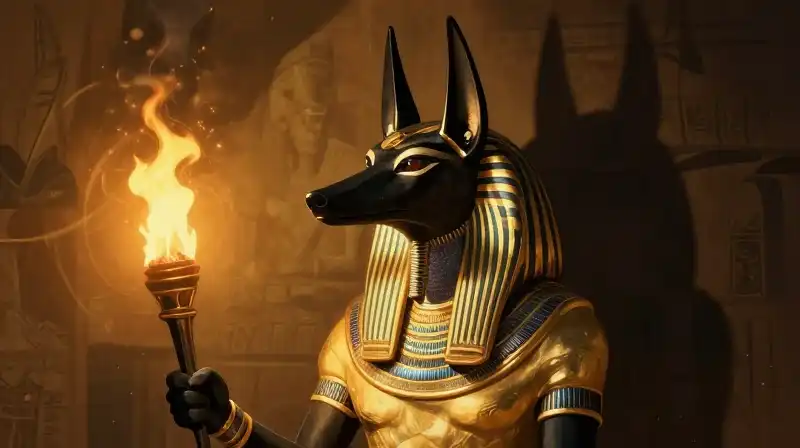
To understand the cultural landscape of Ancient Egypt is to understand the deep relationship between humanity and the natural world. Among the most powerful figures in this tradition is Anubis, the jackal god. Far from a simple creature of myth, Anubis embodies the complex, spiritual transition from life to death—a journey critical to the Egyptian understanding of cosmic order. He serves as both protector and guide, an arbiter overseeing the most profound of human experiences: the passage into the afterlife. His presence is a powerful reminder that in this ancient culture, the boundary between the wild and the divine was remarkably thin.
Anubis is not simply a depiction of a jackal; he is a profound symbol of transition, regeneration, and the necessary duties inherent in maintaining the cycle of life and rebirth. To trace his story is to trace the Egyptian civilization’s obsession with order, transformation, and the ultimate fate of the soul.
The Genesis of the Jackal God
The association between the jackal and the divine was not a sudden artistic choice but likely emerged from careful, long-term observation of the natural world. As sources suggest, the link probably took root in prehistory through the simple, yet powerful, sight of jackals and wild dogs scavenging in cemeteries 1. Because these animals naturally consumed decomposing flesh, they were seen as intimately connected to the process of decay. From this practical observation arose a symbolic protective layer.
The Egyptians appointed Anubis, depicted with a jackal’s head, as the patron deity of funerary rites and embalming 1. This symbolic act was intended to protect the deceased. Interestingly, the god’s original name contained concepts related to decay (Inpu), yet he also held titles referencing a “royal child” 1. This suggests Anubis balanced the harsh realities of mortality with the promise of divine, regal rebirth.
Culturally, his distinctive depiction in black held layered significance. It symbolized regeneration, the fertile, dark soil of the Nile, and the final physical state of the body after meticulous embalming (1, 2). In the earliest expressions of the religion, Anubis was portrayed in his complete animal form, a feature attested in stone inscriptions dating back to the First Dynasty 1.
Anubis as Arbiter and Embalmer
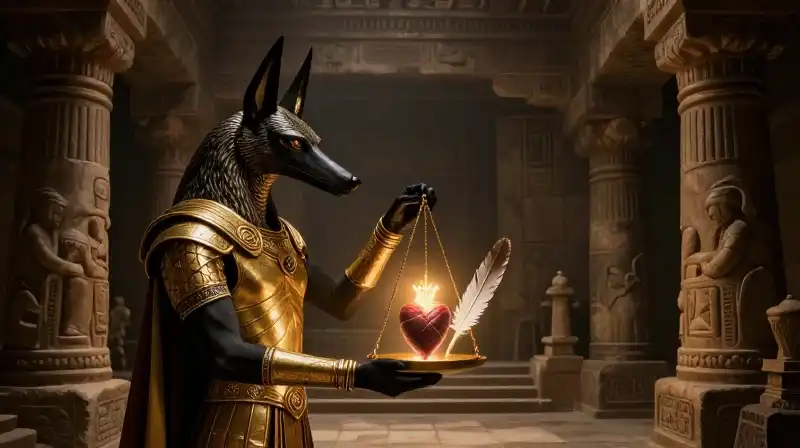
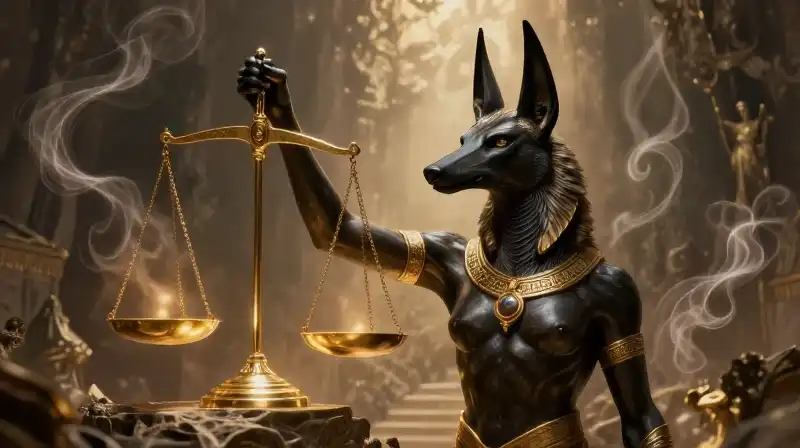
Anubis’s most critical function lay in the spiritual transition of the dead. He was more than just a guard; he was a spiritual arbiter. He served a pivotal role in the “Hall of Two Truths,” acting as a judge during the “Weighing of the Heart” ceremony. This process determined whether the deceased’s soul was pure enough to achieve passage into the Afterlife (1, 2). His role connected the mundane act of burial with the cosmic struggle for eternal life.
His connection to embalming was also deeply integrated into the religious narrative. In the myths surrounding Osiris, Anubis worked alongside Isis during the embalming process. Eventually, this connection solidified, making him a patron god to the skilled embalmers themselves, a role often tied to the sacred organs given to him after Osiris’s death 1.
The Multifaceted Nature of Divine Authority
Anubis’s position in the celestial hierarchy and his familial structure varied across different periods and textual traditions. While he is widely recognized as the offspring of the great deities Isis and Osiris, some earlier traditions place him as the son of Ra or Nephthys 1. His cultural dominance also shifted over time. During the Middle Kingdom, he was eventually supplanted by Osiris in the specific role of Lord of the Underworld, though he retained vital functions elsewhere within the spiritual ecosystem 1.
The Transformation and Regional Reach of Anubis
The tradition of Anubis did not remain static; it proved remarkably adaptable, reflecting the changing cultural currents of Egypt. During the Hellenistic period, the immense cultural intersection between Egyptian beliefs and Greek culture led to a fascinating synthesis. Anubis merged with the Greek deity Hermes, resulting in the figure known as Hermanubis, who continued his essential function as the guide of souls 1.
This divine figure also found acceptance among intellectual circles. Despite sometimes meeting disdain from some Greek and Roman observers who viewed animal-headed gods with skepticism, Anubis was adopted by philosophers like Plato. In this philosophical context, he was viewed as embodying truth, earning him the epithet “the dog of the Egyptians” 1.
Furthermore, the scope of Anubis’s worship extended beyond the Nile valley. In regions like Nubia, his role continued to hold significance, sometimes even being viewed as the husband of his mother, Nephthys, showcasing the rich and varied tapestry of Egyptian regional piety 1.
Answering the Cultural Questions
For those seeking a deeper understanding of this tradition, several questions regarding his symbolism and function often arise, revealing the core meanings of the Egyptian spiritual practice:
- What does a jackal symbolize in Egypt? The jackal primarily symbolizes guardianship, transition, and the sacred connection to the natural process of life and death. It is also tied to the concept of rebirth, embodied in his black coloring (1, 3).
- Who is the jackal demigod in Egypt? The central jackal demigod is Anubis, the patron of funerary rites and the protector of the tomb 1.
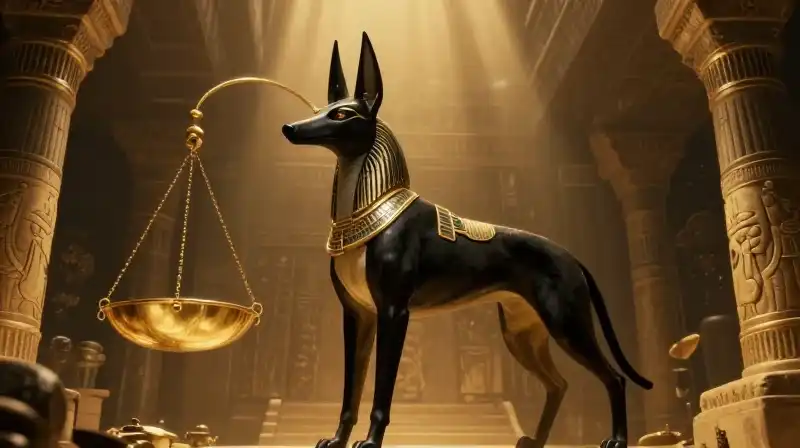
- Is Anubis a cat or jackal? Anubis is consistently depicted with the head of a jackal, distinguishing him from feline deities like Bastet 1.
- Who is higher than Anubis? While Anubis served as a crucial arbiter, the supreme deities and lords of the afterlife, such as Osiris and Ra, occupied the highest places in the cosmic hierarchy 1.
Synthesis: The Meaning of Transition
Anubis’s legacy teaches us that death in Egyptian culture was not an end, but a complex, managed, and divine transition. The association with the jackal—an animal often misunderstood by modern observers—was a deep cultural metaphor for the necessary process of change. He bridges the gap between the physical world of decay and the spiritual realm of eternal order. His various roles, from embalming master to philosophical symbol of truth, reflect a profound belief system where every stage of human existence, even the most solemn, was interwoven with the divine.
Understanding Anubis is not merely studying mythology; it is understanding a cultural imperative: that even in the face of death, there is a path to rebirth, guarded by figures who acknowledge and honor the entire, transformative journey.
References
Footnotes
Frequently Asked Questions
What does a jackal symbolize in Egypt?
The jackal primarily symbolizes guardianship, transition, and the sacred connection to the natural process of life and death. It is also tied to the concept of regeneration and the necessary duties of maintaining the cycle of life and rebirth.
Who is the jackal demigod in Egypt?
The central jackal demigod in Egypt is Anubis, who is depicted with a jackals head and serves as the patron of funerary rites and the protector of the tomb.
Is Anubis a cat or jackal?
Anubis is consistently depicted with the head of a jackal, and he is referred to in the article as the jackal god.
Who is higher than Anubis?
The supreme deities and lords of the afterlife, such as Osiris and Ra, occupied the highest places in the cosmic hierarchy. During the Middle Kingdom, Anubis was eventually supplanted by Osiris in the specific role of Lord of the Underworld.
Related Articles