From Wendigo to Yuki-onna: Global Legends of Winter Mythical Creatures

Introduction
For many communities around the world, winter is not merely a season of reduced light and frozen landscapes; it is a potent spiritual time, a time when the boundaries between the human world and the powerful forces of nature soften. The extreme cold, the unpredictable storms, and the sheer endurance required to live through the freeze have inspired some of the most vivid and complex mythological figures in human folklore. These creatures—be they giants, spectral women, or half-animal demons—serve as living stories. They are not simply monsters; they are the communities’ way of making sense of immense natural power, of codifying social morals, and of providing a narrative framework for cultural resilience.
When Human Emotion Gives Birth to the Blizzard
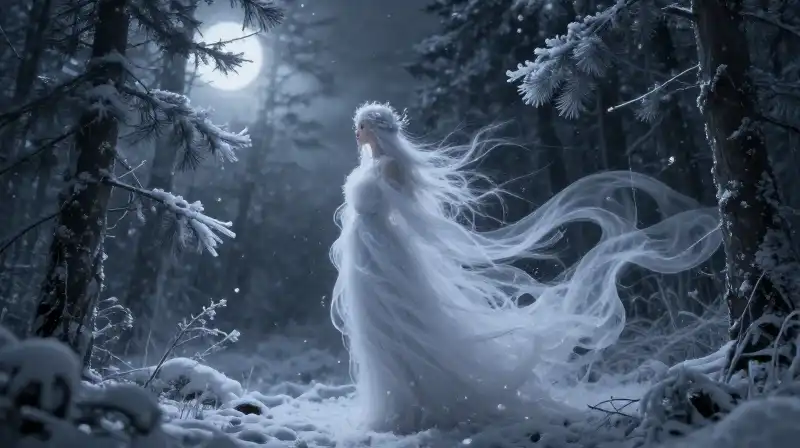
In several traditions, the onset of a severe winter storm is tied not to an indifferent nature, but to the volatile emotions or actions of specific mythical figures. These legends explore the concept that cosmic forces are susceptible to human will or profound sorrow. In Norse myth, the giant Hraesvelgr embodies this volatile force, a figure who brings blizzards by the simple, physical act of flapping his wings 1. This mythological entity externalizes the devastating power of an uncontrollable, chaotic cold. A similar, more emotional linkage is found in the Penobscot legend of Paloma, who is said to bring storms and intense cold when she is angered (1, 2). In Japanese folklore, the Yuki-onna, or Snow Woman, takes this concept to a level of tragic human connection. As a *yokai* (supernatural spirit), her existence is often rooted in profound human suffering—abandonment or tragedy within a blizzard (1, 2). Unlike the brute force of Hraesvelgr, the Yuki-onna represents the delicate, tragic power of sorrow, and her subjugation often requires acts of compassion or non-violent methods, such as exposure to heat (1, 2).
Mythology as Moral Compass: Taboo and Survival
Beyond representing mere weather, many icy creatures function as powerful ethical custodians. They serve to reinforce the social contracts and cultural taboos of the societies that created them. For the Athabaskan cultures, creatures like the Wechuge are understood to be massive, ice-made giants who consume those who transgress community moral boundaries and commit cultural taboos 1. In the Algonquin and Athabaskan traditions, the Wendigo and Chenoo both share characteristics of an icy, devouring heart, symbolizing a devastating hunger for human flesh 1. These myths do not just describe a monstrous predator; they function as a profound warning against selfishness and insatiable desire in the harshest environment imaginable.
The Dual Role of Winter Sovereignty
Northern and Central European traditions often personify winter through powerful, dual-natured figures who command the season. These deities and spirits often exist on a spectrum between benevolent protection and punitive menace. In Gaelic tradition, the Cailleach serves as a powerful and often malevolent queen of winter. She is a figure of great ambiguity, viewed either as the very harbinger of the cold and destructive frost, or as a formidable protector of the wild animals who can freeze the land with her staff 1. In the Scandinavian context, this duality is present in the Nisse, who is a figure of protection for homes during the winter months, contrasting sharply with the punishing role of the Central European Krampus. The Krampus, a half-goat, half-demon, acts as the mythological counterpart to more benign holiday figures, punishing those who do not behave 1. Meanwhile, the concept of a figure who actively governs winter magic is seen in traditions like Ded Moroz (Old Man Frost) and the Snow Maiden, who represent a cultural tradition of seasonal figures who bring frost magic 1. Further extending this, the myth of the Icelandic Hrimfaxi, a horse with a mane of frost, demonstrates how ice is integrated into the celestial narrative, representing the slow, majestic process of frost falling to form dew 1.
Localized Threats and Ecological Narratives
While many myths address the general power of the cold, certain regional traditions focus on creatures that explain highly specific, localized dangers tied to ecology or geography. Japanese mythology features the Kamaitachi, a weasel-like creature with sickle-like claws. This entity attacks victims specifically on their legs during the cold, illustrating how local myths provide cultural explanations for localized seasonal dangers 1. In the Orkney Islands, the Nuckelavee is a powerful winter demon emerging from the sea. This creature is historically feared not just for its appearance, but because its toxic vapors are believed to cause widespread illness and drought, connecting the mythological threat directly to public health crises 1. In North America, the Pamola is depicted as a hybrid creature, serving as the guardian of Mount Katahdin and being considered the spiritual source of the region’s exceptionally harsh winter weather 1. Similarly, among the Indigenous tales of the deep Arctic, Koguhpuk is an Inuit monster noted for avoiding the sun and only appearing during the winter months. Some scholars suggest this figure may reference ancient mammoth remains, grounding the myth in a real, dramatic ecological event 1.
The Enduring Meaning of the Cold
The collective tapestry of these winter mythical creatures demonstrates more than just a fascination with ice; it reveals fundamental cultural concerns. The stories range from the philosophical—exploring the tragic power of human emotion (Yuki-onna) to the social—enforcing community norms against greed and excess (Wendigo). They are a collective human effort to negotiate the brutal beauty of a frozen world. The living tradition of these legends persists because they provide a vocabulary for interpreting the sublime, the terrifying, and the cyclical nature of life itself. These creatures remain powerful symbols, reminding communities that even in the deepest cold, there is profound meaning—be it found in a protective Nisse, a moral warning, or the quiet tragedy of a snow spirit.
References
Footnotes
Frequently Asked Questions
What are some popular winter myths?
Popular winter myths include figures like Hraesvelgr, who brings blizzards, the tragic Yuki-onna, and the malevolent Cailleach, who embodies the cold. Other notable myths include the morality-enforcing Wechuge and the Krampus, who punishes those who do not behave.
Related Articles