Yosuzume: The Japanese Yokai of Warning, Bad Luck, and Evil

Introduction
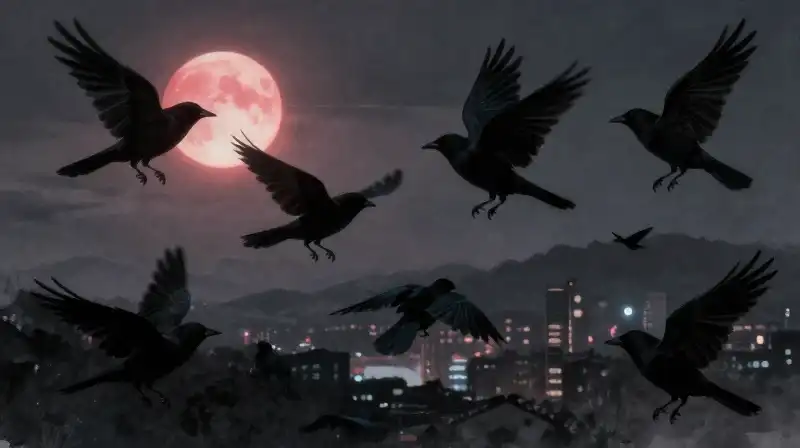
In the remote, mist-shrouded passes of the Japanese mountains, where the forest presses close to the winding dirt roads, the occasional cry of a nocturnal bird carries a weight far heavier than nature’s melody. This is the call of the Yosuzume, or “night sparrow.” For those who journey through these regions, particularly in the deeply forested areas of mountain paths, this avian yōkai is not merely a harbinger of nature, but a complex cultural figure—a living symbol of potent warnings and ancient superstitions.
The Yosuzume defies a simple definition as a creature of ill omen. According to various regional accounts, the perception of the bird shifts dramatically based on its appearance and the circumstances of its arrival. While some local traditions categorize it as a powerful omen of terrible evil and extremely bad luck, especially when it appears in unsettling swarms late at night, others view its presence as a critical sign of imminent physical danger. This duality allows the Yosuzume to function as both a feared apparition and a localized cultural signpost, demanding respect and a specific form of cautious reverence from travelers.
The Geography of the Yokai: Tamoto Suzume
Unlike some widely recognized yōkai that inhabit specific mythical realms, the Yosuzume is rooted in the practical reality of mountain life. Its domain is largely defined by rugged terrain: remote mountain passes and densely forested roads 1. Because of this geographical specificity, the Yosuzume exhibits significant regional variations in how its folklore is understood. In several communities, the bird is regionally identified by the name Tamoto Suzume, or “sleeve sparrow.”
The name Tamoto Suzume speaks to a specific cultural anxiety concerning personal space and misfortune. It was considered highly unfavorable and very bad luck if the Yosuzume were to unexpectedly jump into a person’s sleeve while walking 1. This suggests that the fear surrounding the bird is not just about distant threats, but about sudden, intimate, and uncontrollable encounters that interrupt the safety of one’s journey. This localized naming helps frame the Yosuzume as a threat to the traveler’s personal tranquility and safe passage.
Navigating Threat and Warning: Okuri Suzume
The Yosuzume’s narrative is not a single, monolithic thread of bad luck; rather, it weaves a complex tapestry of caution. For many, its flight is interpreted as a warning of the unseen dangers that inhabit the deep forests. One specific variant of the Yosuzume is known as Okuri Suzume, or “sending sparrow.” This name encapsulates its role as a cautionary figure. The Okuri Suzume is understood to remind travelers to proceed with extra care, advising them to watch their footing and be mindful of the treacherous conditions inherent to mountain paths 1.
This perspective extends beyond mere environmental hazards. In certain localized traditions, the bird’s appearance signals the presence of other, more dangerous entities—such as wild dogs, wolves, or various other powerful yōkai nearby 1. Thus, whether feared as a symbol of misfortune or interpreted as a warning of beasts, the Yosuzume fundamentally serves a cultural function: it alerts the traveler that the boundary between the human world and the wild, supernatural world has been breached, and caution is paramount.
The Mystical Call and Traditional Response
Perhaps the most mysterious aspect of the Yosuzume is its ability to communicate. According to accounts, the bird’s call can be mysteriously heard by only a single individual, even when the birds are traveling in large, conspicuous groups 1. This ability to select a specific listener heightens the perception of the bird’s power and its connection to the spiritual forces of the region. This unique phenomenon dictates how the Yosuzume interacts with the human community.
Due to the perceived threat and ill-omened nature of the calls, travelers in these areas have developed specific, often superstitious, rituals to ward them off. These are not merely casual superstitions, but ingrained traditions held by people whose lives intersect daily with the mountain environment 1. Two common traditional responses include the invocation of the “divine wind of Ise” as a means to quickly dispel the bird from their path 1, and a more direct, localized protective measure.
This localized response dictates that if the calling bird attempts to land near a traveler, the individual may perform a protective chant or ritual that advises striking the bird with a nearby branch 1. These rituals represent a deeply personal and grounded attempt to regain control, to push back the perceived malevolence of the natural and supernatural world, and ensure the safe completion of one’s journey.
Understanding Japanese Bird Yokai and Myth
In the broader landscape of Japanese mythology, there are numerous avian figures, or bird yōkai, that embody various traits. The Yosuzume, categorized among the larger groups of avian yōkai, exists within a rich tradition that explores the connection between nature and the supernatural 1. However, the Yosuzume is often distinguished by its highly localized and dual interpretation—rare birds like the Yosuzume tend to be more linked to direct warnings about dangerous environments than some other bird yōkai that might signify status or cosmic change.
While the Yosuzume itself is primarily associated with mountain travel, the concept of bird yōkai reflects a deep cultural concern across Japan with the natural world. The existence of the Yosuzume reminds us that in these communities, the wilderness is not a passive backdrop, but an active, sometimes sentient force that demands respect, specialized knowledge, and careful observance of tradition.
The Living Significance of the Yosuzume
The Yosuzume is far more than a mythological footnote; it is a piece of living cultural geography. It represents the intersection of practical survival (navigating treacherous mountain paths) and ancient spiritual beliefs. To the people of the regions where it is feared, the bird serves as a powerful, if frightening, method of risk assessment. It is a cultural mechanism for reinforcing cautious behavior and honoring the unpredictable nature of the high wilderness.
By understanding the Yosuzume through the lens of its regional names and specific rituals, we move beyond a mere definition of a “bird yōkai.” We begin to understand how a single, small creature can become a cornerstone of a community’s understanding of danger, luck, and the delicate balance between human life and the supernatural forces that guard the wild spaces of Japan.
References
Footnotes
Frequently Asked Questions
Is there a bird yōkai?
Yes, the article identifies the Yosuzume as an avian yōkai and notes that Japanese mythology includes numerous avian figures categorized as bird yōkai. The Yosuzume itself functions as a complex cultural figure and a cautionary figure within this tradition.
What is an Onmoraki?
The provided article does not contain any information about an Onmoraki.
Related Articles