
Celtic Shield Knot Meaning: Protection, Nature, and Timeless Symbolism

Introduction
The Celtic Shield Knot, characterized by its tightly woven patterns and interlocking loops, is often perceived merely as a beautiful piece of intricate design. However, to view it solely as an ornament is to overlook its profound function within the cultural landscape of Celtic tradition. For centuries, these complex patterns have served not only as visual artistry but also as a repository of spiritual belief and cultural identity. While the lack of surviving written records from ancient Celtic societies means precise, definitive interpretations are often based on logical deduction and historical context 1, the overwhelming consensus points to a system of symbolism designed to represent fundamental truths about existence: the cyclical nature of life, the interconnectedness of the universe, and the necessity of protection.
To genuinely understand the Shield Knot, one must look past its appearance and examine the worldview it embodies. It speaks to a people deeply attuned to nature, seeking to capture the infinite and the elemental within a finite, continuous line. This is not simply a decorative motif; it is a visual philosophy.
The Knot as a Shield: Protection and Spiritual Defense
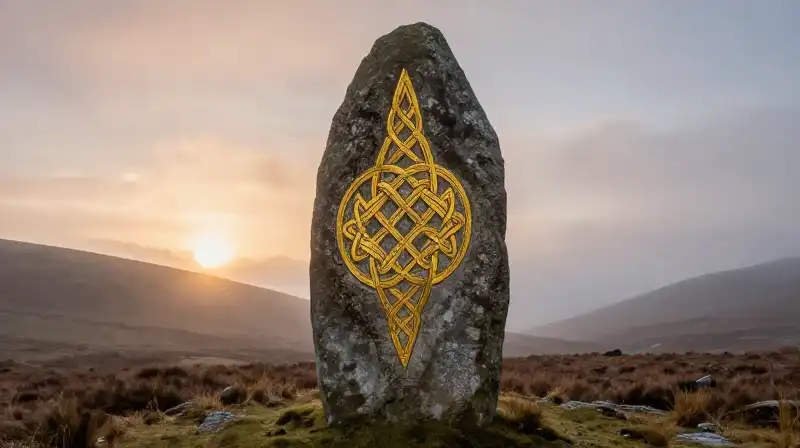
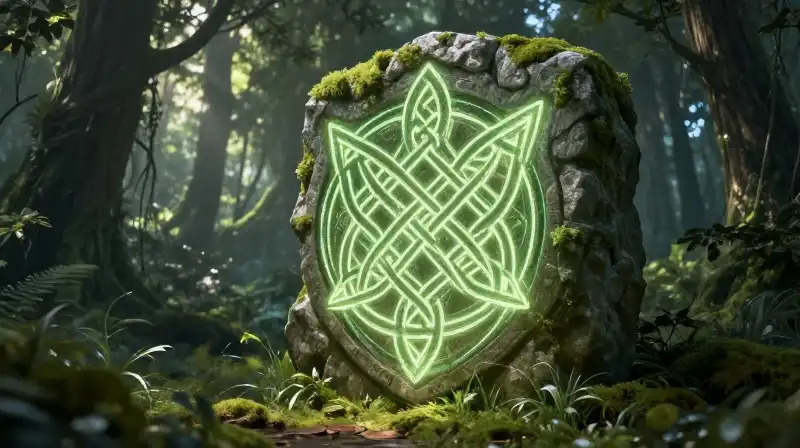
At its most direct and historical level, the Celtic Shield Knot is a symbol of defense. Known historically for its use by warriors and spiritual seekers alike, the Shield Knot functions as a potent talisman. Its intricate weaving is understood to ward off malevolent forces, protect the wearer, and promote spiritual healing 1. When a pattern takes the shape of a shield, it inherently carries the weight of safeguarding the individual and their community, serving as a physical manifestation of spiritual fortitude.
The knot is not merely a static barrier. Its interwoven nature suggests that true protection does not come from a single force, but from the harmony and interconnectedness of multiple elements. In a spiritual context, carrying this symbol implies invoking a continuous field of energy—one where the boundaries between the physical and spiritual worlds are protected and aligned.
Interpreting the Weave: Elements, Eternity, and the Cycle of Life
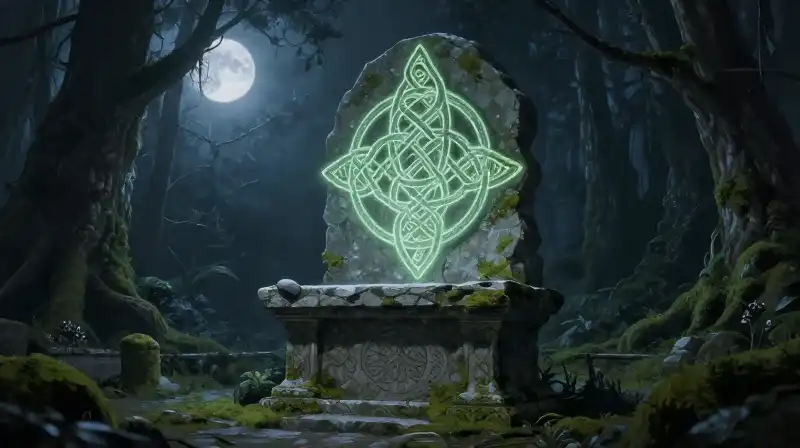
The visual grammar of the Shield Knot is highly coded. One of the most frequently observed interpretations relates to the foundational concept of the universe: the elements. The design of a specific Celtic shield knot—often shown as a circle divided into four distinct quadrants—is interpreted as representing the four elements of nature: earth, air, fire, and water 1. This suggests an attempt to encapsulate the totality of the natural world within a single, cohesive form.
The symbol also functions as a representation of eternity. The unbroken lines that form the continuous loops of the knot represent life’s continuous journey and the eternal flow of existence. This concept is often further nuanced by the structure of the knot itself. While a closed knot symbolizes ultimate unity and completeness, a design featuring an open end may be interpreted as signifying a specific, unfolding individual life journey 1. These small details allow the symbol to speak to both the universal whole and the singular experience of the individual.
The Triquetra and the Language of the Spiritual Flow
While the Shield Knot addresses protection and the elements, other related Celtic symbols provide deeper context to the concept of cyclical existence. The Triquetra, or three-cornered knot, is one such example, though its meaning is subject to different interpretations across time and belief. Today, it is frequently viewed through the lens of contemporary Christian symbolism, representing the Holy Trinity. Conversely, in older, pre-Christian traditions, the Triquetra symbolized the vital link between mind, body, and spirit 1.
This idea of cyclical flow is perhaps most intensely embodied by the Triskele, or triple spiral. This powerful symbol is regarded as the “spiral of life” 1. The Triskele fundamentally represents the ceaseless cycle of existence—death, rebirth, and perpetual renewal. The direction of these spirals also carries significant weight; clockwise spirals are typically linked to harmony with the earth and the energy of the sun, whereas anti-clockwise spirals often reference non-natural elements or spells 1.
The Oak, the Direction, and Ancient Roots
The tradition of complex knotwork and symbolism predates the refinement of the shield knot itself. Early uses of spirals, for instance, can be traced back as far as 3000 BC, appearing on early stone carvings 1. This indicates that the cultural desire to encode meaning through visual repetition and shape is ancient. Furthermore, specific motifs lend unique power to the designs. For example, the Dara Knot, which skillfully mimics the shape of the oak tree, conveys powerful cultural meanings of strength, wisdom, and leadership, owing to the sacred and enduring status of the oak in Celtic life 1.
The precise meaning of a knot could also be specific to the community; it is suggested that certain intricate patterns were historically utilized not just for spiritual meaning, but also to identify different clans or tribal affiliations, anchoring the abstract symbolism firmly in local, human heritage 1.
Living Practice: The Shield Knot in Modern Culture
Today, the Celtic Shield Knot continues to thrive, transitioning from ancient monumental carvings to contemporary forms of expression. Whether worn as a bracelet, incorporated into jewelry, or rendered as a tattoo, the symbol is chosen by individuals seeking to connect with these deep, historical themes of protection and enduring strength. The desire to understand the “Celtic shield knot meaning spiritual” is often a modern quest for a grounding, cyclical philosophy—a way to acknowledge the ebb and flow of life while retaining a sense of ancient continuity.
When considering the meaning, it is crucial to remember that the symbol is versatile. Its interpretation is rarely singular. While it is universally recognized for protection and eternity, its application might signify personal resilience, connection to nature, or commitment to a spiritual journey. It is a multifaceted legacy that allows the wearer to imbue it with meaning that resonates with their own modern context.
Synthesis: The Philosophy of the Continuous Line
Ultimately, the enduring power of the Celtic Shield Knot lies in its refusal to end. It is a philosophy translated into a continuous line. It teaches that life—and the forces that govern it—is not a series of disconnected events, but a single, unbroken, eternal process. When an observer appreciates the knot, they are not just admiring a pattern; they are acknowledging the ancient belief that through the harmony of interconnected forces—be they the elements, the spiritual realms, or the threads of a community—protection, wisdom, and the cycle of life are maintained.
References
Footnotes
Related Articles