Norse God of Storms: Exploring Thor, Njord, and the Pantheon

Introduction
For the peoples of the Norse world, nature was not a backdrop against which life unfolded; it was a dynamic, powerful force that dictated survival. The constant presence of unpredictable weather—ranging from life-giving rain to sudden, violent sea storms—made understanding these patterns paramount to life and commerce 1. In a landscape where travel, food production, and land acquisition hinged entirely on the whims of the sky and sea, the gods served as the ultimate interpreters of chaos. Among the pantheon, the Norse maintained several deities associated with the atmosphere, thunder, and weather, yet the specific focus of a storm-related query often points to the powerful and recognizable figure of Thor.
The Dual Domains: Storm Above and Fury at Sea
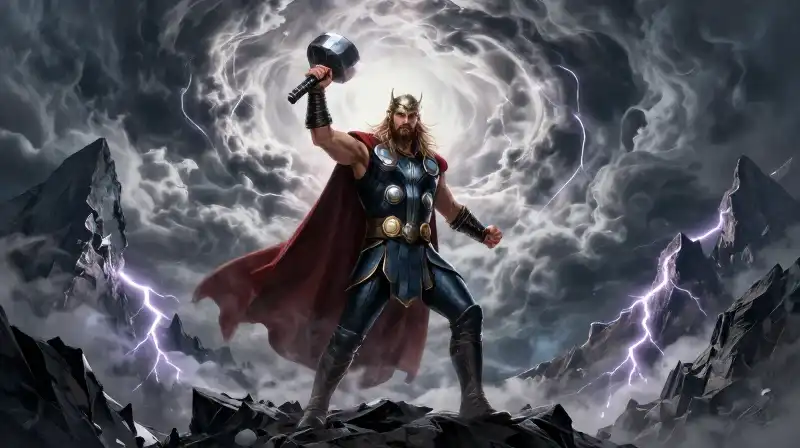
When seeking the Norse god of storms, the answer depends on whether the storm is brewing on the land or raging across the water. Thor is the primary figure associated with the terrestrial elements—the sky, thunder, and atmospheric shifts. He is the thunder god, governing the air, lightning, and general climate 1. His dominion encompasses the forces of wind and rain, placing him as the protector and governor of the land’s natural forces (1, 2). However, for those navigating the treacherous waters of the North Atlantic, the god Njord takes on significant importance. As the sea god, Njord (husband of Skadi) was highly revered by sailors for his specific control over weather at sea 1. Where Thor managed the weather in the realm of man, Njord’s role addressed the most immediate and lethal threat to Viking voyages: the sudden, powerful storms that imperiled raiding ships and trade vessels 1. Thus, while Thor is the quintessential “god of storms” for the average farmer or community member, Njord represents the specific, dangerous power of maritime weather.
The Hammer of Defiance: Thor and the Forces of Nature
The prominence of Thor was immense, not just because of his vast powers, but because of how he was understood linguistically and socially. His name, Þórr, has roots in the Proto-Germanic word for ‘thunder,’ creating a direct linguistic link between his divine nature and powerful auditory phenomena 1. He is fundamentally tied to the raw power of nature. For the Norse people, who lived under the constant pressure of change and external pressure, Thor’s symbol, the mighty hammer Mjölnir, took on more than just religious significance. During the Viking Age, the dedication to Thor—and the wearing of his emblems—served as a form of cultural and spiritual defiance against the encroaching process of Christianization across Scandinavia 1. His power was a tangible, recognizable force, recognized even by Roman accounts who identified him as “Hercules,” pointing to a cross-cultural acknowledgment of his strength and powerful, destructive force 1.
Beyond Violence: The Role of Freyr and Agricultural Harmony
A common misconception is that Norse weather gods were solely figures of conflict and destruction. While Thor governs the fierce elements, the traditions of the North also highlight the necessity of balance, embodied by the god Freyr. Freyr’s domain centered on sunshine, fair weather, fertility, and the good harvests (1, 3). Freyr’s function was critical for societal peace and prosperity. While Thor dealt with the unpredictable fury, Freyr provided the conditions for the cycle of growth and plenty. He was especially celebrated during the festivals related to the harvest, linking the divine maintenance of weather directly to human labor and the community’s ability to sustain itself 1. This suggests that for the Norse, a functional world required not only the raw power of storms but also the reliable gifts of the sun and fertile earth.
A Fluid Pantheon: Overlapping Attributes and Regional Nuances
The tradition of the Norse does not assign powers in rigid, exclusive categories. Scholarly sources indicate that the Norse mythology is not defined by a singular god holding one monolithic power. Instead, various deities frequently had overlapping attributes 1. This fluid nature reflects a belief in how nature itself operates—no single force is entirely isolated. For example, control over specific aspects of the sea was sometimes delegated to lesser or regional deities, such as Ran or Tyr, in addition to the major figures like Njord 1. Furthermore, the internal structure of the divine world was not strictly patriarchal; myths recorded events, such as Thor fathering gods with various figures, which demonstrates fluid and complex divine relationships 1. This nuance reminds the reader that traditional assignments are not immutable laws but flexible reflections of a diverse and evolving spiritual landscape.
The Living Meaning of the Storm God
To truly understand the Norse connection to storms, one must look past the definitions of gods and see the relationship between the people and their environment. These traditions reveal a profound engagement with the natural world, where every atmospheric shift held theological weight. The question of “Who is the Norse god of the sea storms?” is answered by the shift from Thor, the atmospheric titan of the land, to Njord, the dedicated patron of the treacherous deep. But the full picture is painted by the inclusion of Freyr, who represents the necessary grace that allows the storms to pass into fruitful seasons. The enduring relevance of these figures lies in their representation of the necessary tensions of existence: the strength required to defy chaos (Thor), the wisdom needed to navigate peril (Njord), and the fertility needed to endure (Freyr).
References
Footnotes
Frequently Asked Questions
Who is the Norse god of the sea storms?
Njord is the sea god highly revered by sailors for his specific control over weather at sea. His role addressed the sudden, powerful storms that imperiled raiding ships and trade vessels navigating the North Atlantic.
Related Articles