Imsety: Egyptian Son of Horus and Protector of the Liver

Introduction
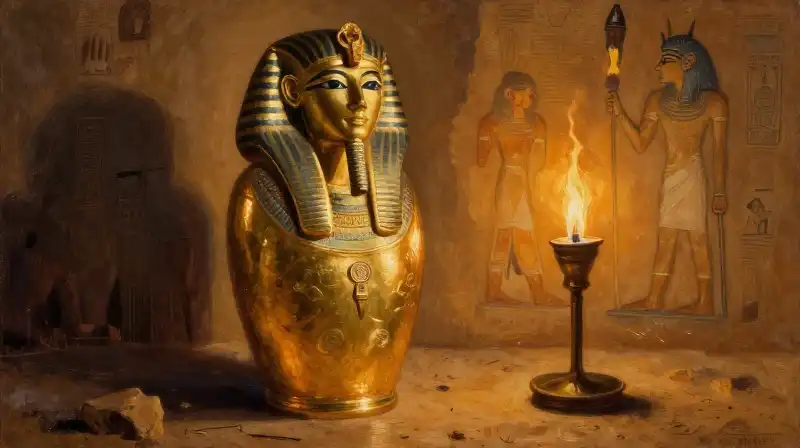
In the rich tapestry of ancient Egyptian beliefs, few figures embody the profound intersection of the mundane and the divine quite like Imsety. He is not simply a name from an old text, but a vital part of a deeply held tradition concerning the preservation of the self during the perilous journey into the afterlife. Imsety is recognized as one of the Four Sons of Horus, a funerary grouping of deities whose collective function was to protect the deceased body and its vital organs (1, 2). While the gods of this group often took recognizable animal forms, Imsety is distinguished by his frequent depiction as a human figure on canopic jar lids (1, 3). To understand Imsety is to look past simple mythology and into a sophisticated cultural practice—one that equates the human body with the cosmos and mandates divine guardianship over the physical vessel needed for rebirth.
The Guardian of the Inner Self
The primary function of the Sons of Horus revolved around the sacred process of mummification and the subsequent need to safeguard the internal components of the body. Each god was assigned a specific organ, acting as a permanent divine sentinel. Imsety is most universally associated with the protection of the liver. However, this assignment carries a degree of scholarly uncertainty, reflecting the complexity of ancient naming conventions. Some researchers suggest that the name Imsety may have originally served as a personification of the dill herb, or perhaps directly represented the Egyptian word for “liver,” hinting at a cultural connection between flora and the sanctity of internal life (1, 3).
This protective duty was not merely practical; it was deeply theological. Texts instruct Imsety to assist in revivifying the deceased and to help strengthen their “house”—the body—in accordance with the decrees established by powerful deities like Ptah and Ra 1. His role solidified the belief that the physical integrity of the deceased was essential for their successful transition and rebirth. His presence on canopic jars and sarcophagi serves as a continuous reminder of this central role, ensuring the vital components remained untouched by the chaos of the underworld (1, 2).
Divine Kinship and Cosmic Alignment
Imsety’s identity was further interwoven into the broader divine geography of Egypt. While he was fundamentally recognized as a Son of Horus, some older or alternative texts identified him differently, as potentially a son of Atum, Geb, or Nut, showing the fluidity and layered nature of ancient Egyptian pantheon 1. This multiplicity in his parentage reflects the way individual deities could integrate into multiple divine lineages to accommodate shifting cultural narratives.
Central to his traditional narrative is his intimate pairing with the protective goddess Isis. This consistent coupling in traditional Egyptian myth emphasizes a theme of shared guardianship and maternal protection within the divine sphere (3, 2). Beyond his roles in funerary rites, Imsety’s influence extended into the cultural understanding of the cosmos. He was traditionally linked to the direction of the South and the city of Nekhen in Upper Egypt. This linkage underscores a crucial ancient Egyptian perspective: the physical orientation of a body within a burial site was viewed as directly correlating to cosmic alignment—the idea that physical placement mirrored the heavenly order (1, 2). This belief shaped the layout of burial complexes for millennia.
The Scope of Imsety’s Influence
The reach of Imsety’s protective traditions was immense, spanning over several vast periods of Egyptian history. References to his protective functions and his appearance in the funerary Book of the Dead can be found in texts dating from the Old Kingdom all the way through the Greco-Roman eras (1, 2). This longevity demonstrates that his importance transcended temporary cultural shifts. Across the ages, he remained a prominent figure in funerary rituals, safeguarding the deceased and his brothers—Duamutef, Qebehsenuef, and Hapi—to ensure a successful and secure passage through the Duat, the underworld (1, 2).
For those researching the specific iconography, it is notable that unlike the often zoomorphic forms of his brothers, Imsety’s consistent human portrayal on canopic jar lids solidified his unique identity and emphasized his direct, human-centered role in guardianship. This visual distinction is key to understanding how he was distinguished within a group of powerful, diverse divine beings (1, 3).
Protecting the Body: An Examination of Function
To directly address the question of what Imsety protected, we must understand the broader function of the Son of Horus tradition. While Imsety is most commonly cited as the guardian of the liver, the function of the entire quartet is one of meticulous, systematic preservation. In the wider tradition, the other Sons guarded the lungs (Hapi), the stomach (Duamutef), and the intestines (Qebehsenuef), although the nuances of these assignments could vary (as noted by cultural observers regarding the pattern and variation of these roles). Imsety’s specialized protection of the liver was part of a sophisticated strategy: ensuring that the vital internal mechanisms of the deceased remained intact and divinely sanctioned for the rebirth process (Competitor Snippet referenced for context). This was not just about preservation; it was about securing the foundation of the soul’s journey.
The Enduring Legacy of the Tradition
Imsety stands as a powerful example of a tradition where the sacred and the practical are inseparable. He is not a god defined by war or grand cosmic events, but by a fundamental, nurturing responsibility: the preservation of life after death. The practice of enshrining Imsety and his peers within funerary contexts reminds us that the Egyptian worldview prioritized the physical body not as a mere husk, but as a temple—a necessary component for the spiritual return to existence. Today, studying Imsety allows us to glimpse how ancient communities synthesized biology, geometry (the North/South orientation), and divine law to create a comprehensive system of meaning. His legacy is a testament to the cultural belief that even in the deepest transition of life, protection and alignment were paramount.
References
Footnotes
Frequently Asked Questions
What did Imsety protect?
Imsety is most commonly cited as the guardian of the liver. As one of the Four Sons of Horus, his broader function, along with his peers, was to protect the deceaseds vital organs and body to ensure their successful transition into the afterlife.
Related Articles