Thoth and the Ibis: The Egyptian God of Writing and Wisdom

Introduction
In the vast tapestry of ancient Egyptian life, where gods and people shared a sophisticated relationship with order, knowledge was the ultimate currency. While figures like Ra represented the powerful, solar force of creation, it was a subtle, more intellectually oriented deity who governed the structure of human understanding and divine law: Thoth. Often known by his ancient name, Djehuty—which translates to “He who is like the Ibis”—Thoth is not merely a mythological character but the embodiment of the scribal tradition, the invention of language, and the meticulous record-keeping that allowed Egyptian society to function. To understand Thoth is to grasp the essential Egyptian reverence for literacy, logic, and the harmonious interplay between the cosmic and the mundane.
The Ibis: A Sacred Vessel of Knowledge
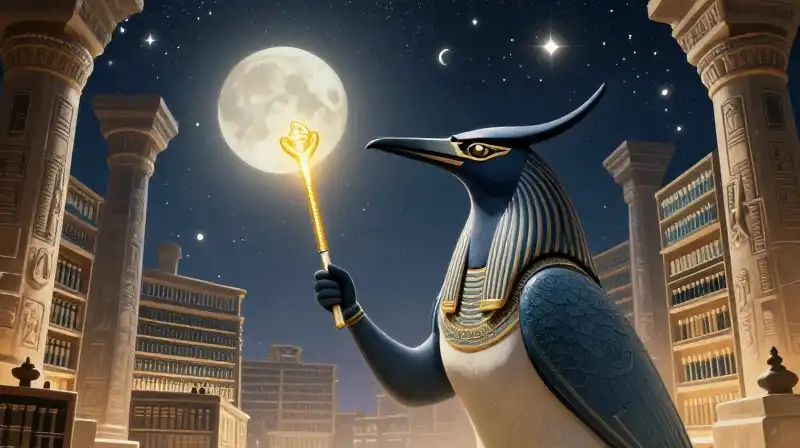
The deliberate choice to depict Thoth with the head of an ibis is rooted deeply in the cultural and symbolic significance of the bird within ancient Egypt. Far from being a mere avian decoration, the ibis carried profound attributes of patience and profound knowledge 1. This bird was seen as a vessel for wisdom. Culturally, the association was so strong that the ibis itself became a potent symbol for individuals engaged in scribal professions, those who dealt in the preservation and creation of written knowledge (1, 2).
The physical representation of Thoth in art—a human form crowned with an ibis head—is believed to be a deliberate choice because the bird was intrinsically linked to divine wisdom. Some scholars propose that the physical posture of the bird, specifically how it feeds, may have symbolized the physical act of writing, suggesting the ibis head may have stood in for a pen or stylus 1. This connection elevated the humble act of writing into a divine act, overseen by the god who embodied perfect record-keeping.
The Architect of Order: Thoth’s Divine Functions
Thoth’s role extended far beyond merely writing; he functioned as the divine architect of cosmic and social order. As the “scribe of the gods,” he was credited with inventing the hieroglyphic writing system, the very method that allowed the Egyptians to record their myths, histories, and rituals—effectively giving structure to their civilization (1, 2). Furthermore, he is credited with creating the structured, cyclical nature of time, including the 365-day calendar (1, 2).
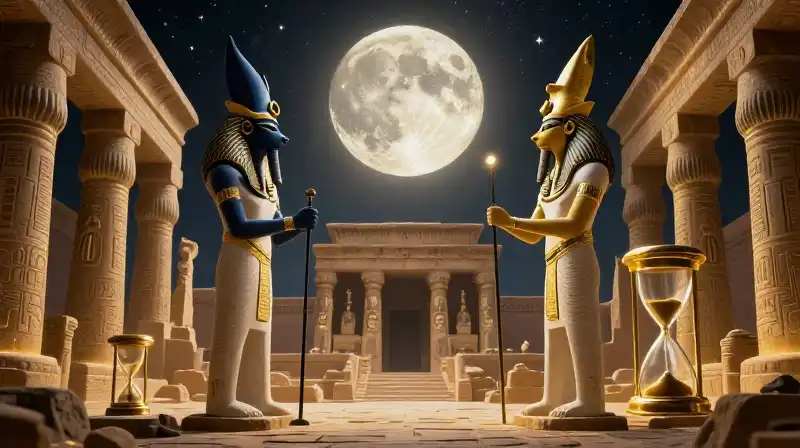
In the celestial hierarchy, Thoth occupied a critical position as a Moon god. This role was underscored by his portrayal alongside the Sun god Ra, often depicted together on the nightly journey across the sky. He was the regulator, the balancer, ensuring that the forces of light and shadow, life and death, moved according to a divine, intelligible pattern (1, 2). His divine functions were never random; they were all about maintaining equilibrium and preserving truth.
Record Keeper of the Duat and Arbiter of Disputes
Perhaps one of the most critical and profound roles Thoth held was within the Duat, the realm of the dead. In this highly formalized underworld journey, Thoth served as the ultimate bookkeeper. He was the meticulous record-keeper who documented the outcome of the heart-weighing ceremony—a pivotal moment where the deceased’s heart was weighed against the feather of truth to determine their passage into the afterlife (1, 2). Without Thoth’s precise documentation, the sacred ritual would have been meaningless.
His function extended to the living world as well. Thoth was regarded not just as a chronicler, but as a wise arbiter. He often mediated complex divine and mortal disputes, sometimes even advising communities by suggesting assemblies to find consensus and resolve intractable problems (1, 2). This suggests that in the Egyptian view, true knowledge was not just about recording facts, but about applying logic and wisdom to find functional, equitable solutions.
The Scribe’s Link: A Tradition of Intellectual Veneration
The relationship between Thoth and the ancient Egyptian scribal class was symbiotic. The scribes revered Thoth because his divine attributes mirrored their own sacred duty. As they practiced writing, they were operating under the patronage of the god who had brought the concept of writing itself into existence. This veneration was not just abstract; the ibis symbolized the professional identity and the inherent intellectual nature of the scribe (1, 2). The temples dedicated to him, such as the one once located at Hermopolis, served as vital centers for this cultural and intellectual life (1, 2).
It is important to note the various names and forms Thoth took across time and translation—including *Djehuti* or *Techu*, and the Greek *Thoth* (1, 2). Though later structures of his temples may have suffered destruction, the tradition of his intellectual significance endured, leading later cultures to regard him as the ultimate author of knowledge, encompassing mathematics, science, and philosophy (1, 2).
Addressing Common Queries and Misconceptions
The cultural complexity of Thoth has led to several misunderstandings, particularly regarding his animal representations. It is common to wonder: Is Thoth a monkey or an ibis? In traditional Egyptian iconography, Thoth is primarily and most powerfully associated with the ibis. While he was occasionally depicted with other forms or animals, the ibis head is the definitive symbol of his wisdom and scribal nature (1, 3). The ibis is an ancient, sacred bird, and the association with it speaks directly to patience and intellectual discipline. The ibis is not itself a god, but it serves as the sacred vessel for the god’s wisdom.
Living Legacy: The Intersection of Tradition and Thought
Thoth’s tradition provides a powerful reminder of how intellectual pursuits can become the foundation of a religious and cultural identity. His life and roles demonstrate that for ancient Egyptians, writing was not just a record-keeping tool; it was a mechanism for maintaining cosmic balance and achieving truth. He serves as an enduring symbol that knowledge, logic, and the ability to document and articulate experience are fundamental pillars of civilization. The tradition of Thoth teaches us to value the meticulous act of recording, for within that recording lies the potential to define order, create time, and ultimately, preserve the essence of life across the epochs.
References
Footnotes
Frequently Asked Questions
Why is Thoth associated with ibis?
Thoth is associated with the ibis because the bird carries profound attributes of patience and profound knowledge, serving as a sacred vessel for wisdom. The ibis head is also the definitive symbol of his scribal nature and intellectual discipline.
Is Thoth a monkey or an ibis?
In traditional Egyptian iconography, Thoth is primarily and most powerfully associated with the ibis. The ibis head is considered the definitive symbol of his wisdom and scribal nature.
Is ibis an Egyptian god?
No, the ibis is not a god itself, but it serves as the sacred vessel for the god Thoth’s wisdom. It is an ancient, sacred bird that is the definitive symbol of the gods scribal nature and profound knowledge.
Which Egyptian god looks like an ibis?
Thoth is the Egyptian god primarily associated with the ibis, and he is traditionally depicted with an ibis head.
Related Articles