Demeter: The Olympian Goddess of Harvest and the Cycle of Life

Introduction
In the tapestry of ancient Greek civilization, few deities encapsulate the fundamental necessity of life as profoundly as Demeter. She is not merely a figure in a mythological narrative; she is the “Earth-Mother,” the Olympian goddess fundamentally tied to the bounty of the soil, the flourishing of grains, and the cycle of human survival through agriculture (1, 2). For the communities that lived and farmed across ancient Attica, Crete, and beyond, Demeter was the sacred law made manifest in the harvest. Her worship transcended the simple act of farming; it was a profound spiritual engagement with the cyclical nature of existence—a devotion to the “giver of customs” and the inevitable transition between growth and decay.
The Dual Role: Provider and Regulator of Life
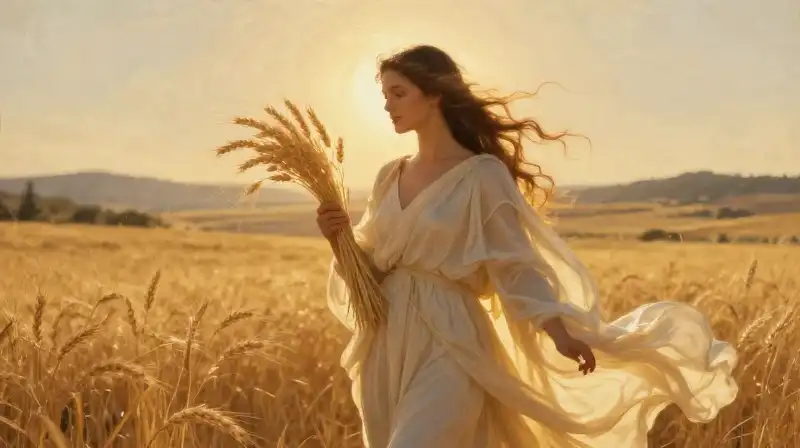
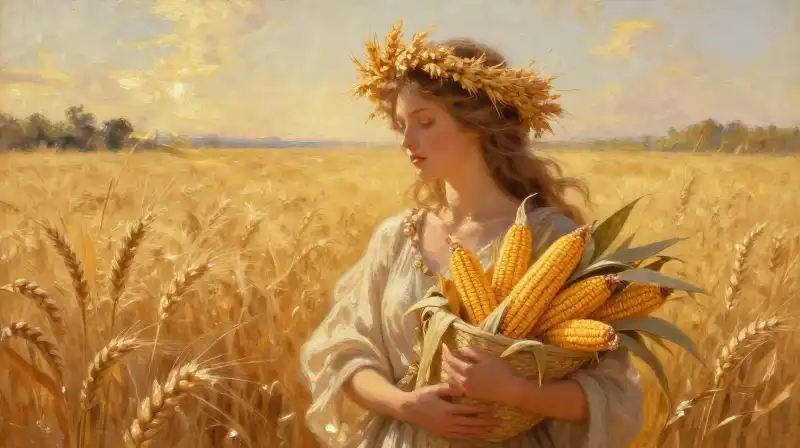
Demeter’s cultural power resided in her role as the primary provider of sustenance. In ancient Greece, where the yield of the land dictated the health and survival of the city, Demeter was the ultimate source of prosperity 1. Her domain included grains, fields, and the agricultural rituals that transformed simple seeds into the foundation of civilization. She was often revered as a “Grain-Mother,” presiding over the sacred and sometimes difficult relationship between humanity and the wild earth 1. However, her influence extended far beyond the harvest. Scholarly tradition suggests that while her primary icon is the sheaf of wheat or the cornucopia, her significance expanded to include the regulation of society itself 1. Practices like the Thesmophoria—a secret, strictly female-only festival—honored her specifically as the “bringess of divine order” or the “giver of customs” 1. This indicates that in her communities, the agricultural cycle was intrinsically linked to the maintenance of social and moral law, making her a deity of structure as well as crops.
The Great Seasonal Narrative: Demeter and the Cycle of Existence
The most celebrated narrative surrounding Demeter is the story of her daughter, Persephone. While mythological accounts vary regarding the specifics of the abduction and where it took place—from the mountains of Mount Aetna to different regions across Attica 1—the story’s central function is cultural and deeply rooted in agrarian reality. The myth serves as a powerful explanation for the seasons. As Demeter grieved the loss of Persephone to the Underworld, the fields went barren 1. It is this profound grief that triggered the winter. When Persephone was returned, Demeter’s joy allowed the crops to flourish (1, 3). This narrative structure was far from entertainment; it was an interpretive framework, a mythological “software” that allowed people to understand the rhythmic, cyclical patterns of planting, growth, and necessary rest (1, 3).
The Mysteries: Linking the Soil to the Soul
Demeter’s relationship with the cycle of life reached its most profound and sophisticated expression in the Eleusinian Mysteries (1, 2). By focusing on Demeter and Persephone, the mysteries offered initiates a link between the visible, physical cycle of the earth and the spiritual transition of the human soul. These rituals didn’t just concern crop health; they promised the initiates a future beyond the living world—a “happy afterlife” that mirrored the promise of the harvest. In this context, Demeter became more than a field goddess; she was a chthonic divinity who bridged the gap between the subterranean forces and the ordered world above (1, 2). She presided over the “birth” (growth) and the inevitable “rebirth” (the cycle of planting), offering a profound comfort that existence, like the seasons, is fundamentally continuous.
From Greece to Cyprus: A Panhellenic and Global Presence
The influence of Demeter was not limited to the Aegean. She was a highly panhellenic figure, meaning her worship spanned various Greek and interconnected cultures (1, 2). In the Roman world, her attributes and functions were absorbed by Ceres, the Roman equivalent of the goddess of agriculture. Similarly, her connections to Cybele demonstrate shared, foundational traditions across the Mediterranean (1, 2). Her reach even extended to Cyprus, where her cult was integral to the local concept of grain-harvesting and its practical application 1. These variations confirm that Demeter’s essence—the power of the earth to sustain life—was a universal cultural motif, translated into distinct, regional forms to match local soil, climate, and spiritual needs.
Regional Expressions and Modern Interpretations
While the overarching identity of Demeter remains constant, regional lore reveals the adaptability of her character. For example, the Arcadian tradition featured the “Black Demeter,” who underwent a tragic transformation, depicted with the head of a horse after an encounter with her brother, Poseidon 1. This variation demonstrates how regional narratives personalized and dramatized the divine, rooting her divine power in specific local traumas and myths. In contemporary cultural studies, scholars debate the etymology of her name; while some interpret it as “Mother-Earth,” others find that it may stem from a specific Cretan word related to “Barley,” suggesting a deity defined specifically by her role as the “mother and giver of food generally” (1, 2).
Conclusion: The Enduring Symbol of the Grounded Life
Demeter’s cultural significance far exceeds the realm of farming. She represents the essential contract between civilization and the natural world. Her legacy teaches that the richness of life is dependent on the patience of the soil and the cyclical rhythm of renewal. She is the guardian of the grain, yes, but also the keeper of the sacred customs, the source of divine law, and the symbol of the ultimate continuity that sustains both the planet and the human spirit. By understanding Demeter, we understand the deep, practical reverence ancient communities held for the earth—a reverence that is both scientifically grounded in seasons and profoundly spiritual in its meaning.
References
Footnotes
Frequently Asked Questions
Which Greek god is the god of harvest?
Demeter is the Earth-Mother and an Olympian goddess fundamentally tied to the bounty of the soil, the flourishing of grains, and the cycle of human survival through agriculture. She was revered as the sacred law made manifest in the harvest.
Who is the male god of harvest?
Based on the article, there is no mention of a male god of harvest; the text focuses entirely on the goddess Demeter.
Is Dionysus a god of harvest?
The article does not mention Dionysus, and therefore it does not provide any information about whether he is a god of harvest.
Who got Demeter pregnant?
The provided article does not mention who got Demeter pregnant.
Related Articles