Surtr in Norse Mythology: Guardian of Múspellheim and Ragnarök

Introduction
In the tapestry of Norse mythology, figures of extreme elemental power often serve to frame the boundaries of existence—what is created, what is destroyed, and what must be reborn. Among these powerful archetypes is Surtr, the great fire giant. More than merely a villain or a monster, Surtr is a central figure in the profound and cyclical cosmology of the Norse tradition, serving as the guardian of Múspellheim and the foretold herald of Ragnarök. His narrative is less about simple malice and more about the inevitable, consuming forces of change that govern the universe.
While Surtr is frequently encountered in popular culture and modern media as a hulking brute, a closer look at the primary Eddic sources reveals a tradition far more nuanced. He represents the ancient, powerful forces of fire, located in the south and destined to lead the world into its final, burning transformation. Understanding Surtr requires moving past a basic definition of a ‘giant’ and delving into the deep cultural and regional interpretations of his role.
Defining the Fire Lord: Surtr’s Position in the Cosmology
Surtr (or Surt) belongs to the lineage of the “Sons of Muspell,” a class of beings strongly associated with heat and elemental power (1, 2). He is fundamentally a *jötunn*—a giant—but this classification requires careful contextualization. While pop culture frequently imagines him as physically enormous, scholarly analysis of the Poetic and Prose Eddas indicates that his size is not explicitly detailed in the primary sources 1. This suggests that the term *jötunn* carried a broader cultural connotation—a powerful, elemental being—rather than exclusively describing immense physical stature 1. Surtr’s function is defined by his station: he is the resolute guardian of the subterranean fire realm of Múspellheim, a place of intense, primordial flame (1, 2).
The name itself and the concept of the world-ending fire hold real resonance in Northern cultures. The powerful association between Surtr and volcanic heat has manifested in physical geography. For instance, the volcanic tunnels known as Surtshellir in Western Iceland and the island of Surtsey, located south of Iceland, are named directly after him, marking a visible link between mythology and the physical landscape 1.
The Role in Ragnarök: The Consuming Flame
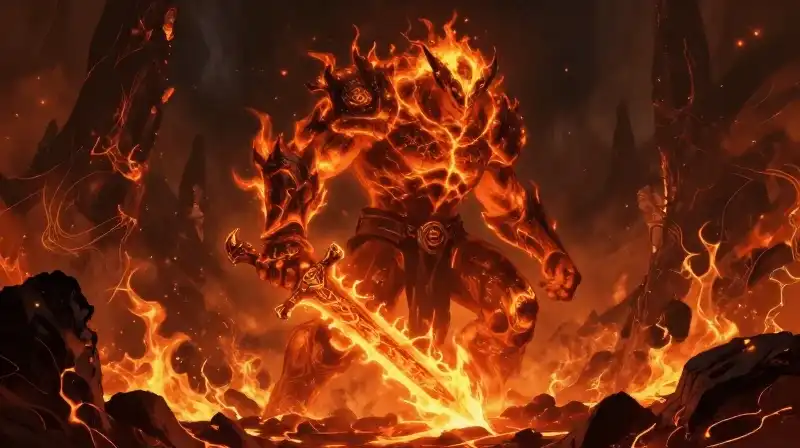
Surtr’s most crucial narrative function appears during Ragnarök, the prophesied cycle of the world’s destruction. He is foretold to emerge from the south, a fiery agent whose arrival signals the ultimate confrontation between the forces of order (the Æsir) and the chaotic elements (the giants) (1, 2). His primary role is not merely to participate in the conflict but to lead the final, cataclysmic event itself. The Prophecy dictates that he will unleash intense flames and wield a very bright sword, consuming the world after the great forces have exhausted one another (1, 2). According to the writings in the Poetic Eddas, Surtr is destined to engage in a major battle against Freyr, a clash sometimes referenced as “Beli’s bane” 1.
The Prose Edda, specifically the *Gylfaginning*, elaborates on this conflict, describing how Surtr will engage the Æsir, ultimately flinging fire over the earth to burn the world entirely (1, 2). This portrayal solidifies his identity not just as a participant, but as the ultimate physical embodiment of the necessary cosmic ending.
The Cycle of Renewal: Beyond Destruction
One of the most striking aspects of the Surtr narrative is that his role is not merely one of absolute annihilation. While his fire consumes the world, the Norse cosmological cycle allows for a return to life. Following the fire of Surtr, a new and fertile world emerges. This outcome is a vital element of the cultural understanding of the cycle—destruction is necessary for transformation. Within this new world, the human couple, Líf and Lífþrasir, are identified as the sole survivors who escaped the consuming flames to start a fresh existence (1, 2).
This narrative arc provides a perspective on the tradition that goes beyond simple good-versus-evil. Surtr’s destructive power is interpreted within a larger framework of cosmic balance—the “end” that allows for a new beginning. This cyclical theme has inspired various modern adaptations and artistic expressions across global media and music, reflecting the timeless fascination with necessary endings 1.
Addressing Common Interpretations and Terminology
In discussing Surtr, several common misconceptions regarding his name and attributes often arise. There is sometimes confusion over the exact spelling; whether it is Surt or Surtr is a matter of linguistic variation, and the term Surtr is the most recognized in modern discourse 1.
Furthermore, the relationship between Surtr and his supposed companion, Sinmara, is a point of scholarly debate. While some ancient manuscripts suggest a connection between the two, this association relies on uncertain interpretations of archaic Old Norse texts 1. Similarly, the name Surtur is often used, but scholars clarify that Surtr and Surtur refer to the same core figure within the mythology.
The association between Surtr and fire is noted as extremely strong by cultural scholars, with comparisons often made to other personifications of heat and energy in the wider Norse tradition 1.
Synthesis: The Meaning of Surtr’s Fire
To truly understand Surtr is to understand the acceptance of cosmic impermanence. He is a manifestation of the untamable, necessary forces of the universe. He is the fire that burns the old forms away to clear the ground for the new. Rather than seeing him as a purely malevolent figure, Surtr occupies a powerful place as the elemental agent of change. His story, rooted deeply in the rugged landscapes of Iceland and the powerful oral traditions of the North, offers a profound meditation on the inevitability of cycles—that even the most total destruction holds the seed of renewal.
References
Footnotes
Frequently Asked Questions
Is it surt or Surtr?
According to the article, the confusion over whether it is Surt or Surtr is considered linguistic variation, with Surtr being the most recognized term in modern discourse. The text further clarifies that Surtr and Surtur refer to the same central figure in Norse mythology.
Is surt the same as Surtur?
Yes, scholars clarify that the name Surtur is often used, but Surtr and Surtur refer to the same core figure within the mythology. The article notes that the variation between Surt, Surtr, and Surtur is a matter of linguistic variation.
Related Articles