Narmer vs Menes: The Great Debate over Egypts First Pharaoh

Introduction
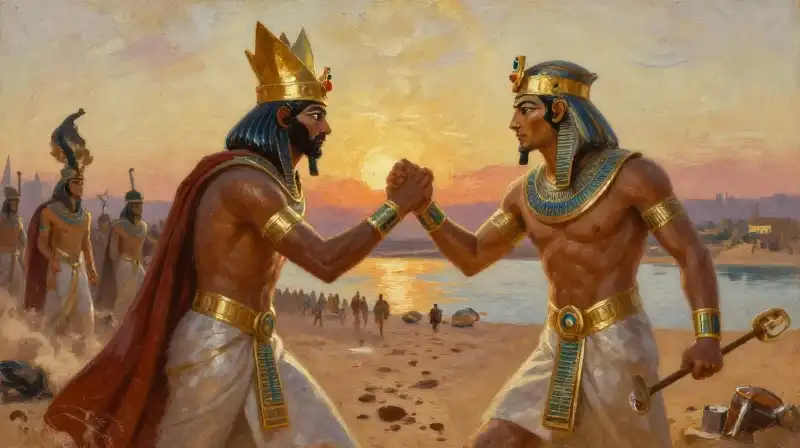
The concept of a unified Egypt is one of the most enduring narratives in human history. At its core lies the dramatic transition from a land of warring regional chiefdomss to a single, powerful kingdom. This shift, which began during the Early Dynastic Period—traditionally placed around 3100 BC—is inextricably linked to the figure of the first pharaoh. However, the identity of this foundational ruler remains one of the most compelling and debated topics in Egyptology. Is the founder Narmer, the king celebrated on grand palettes, or is he Menes, the figure codified by ancient dynastic records? This ambiguity is not merely an academic footnote; it speaks to the complex interplay between archaeological fact, royal propaganda, and the cultural need for a definitive origin myth.
The Narrative of Unity: The Case for Narmer
For many modern scholars, the name Narmer is the primary candidate for the first pharaoh. The evidence supporting his role as the agent of unification stems largely from the material culture of the Early Dynastic period 1. The Narmer Palette, a masterpiece of ancient Egyptian art, serves as the most potent visual argument for his power. This colossal artifact portrays Narmer wearing the double crown—a symbol representing the political union of Upper and Lower Egypt—while simultaneously demonstrating his military prowess and authority over both regions 1. Narmer’s identity is further bolstered by the organizational evidence found in the Abydos necropolis. Seal impressions and early king lists, such as those found in these burials, record rulers in an intended sequence that begins with Narmer. These archaeological findings provide concrete evidence of a strong foundational role, suggesting he was the pivotal figure who established the official royal lineage 1. Furthermore, the progression of royal titles evolved from personal names, like Narmer (which is derived from hieroglyphs representing “catfish” and “chisel”), to more formal, throne-based names known as “prenomens” or “Menes” 1.
The Historical Veil: The Menes Tradition
While the archaeological focus often rests on the powerful symbols of Narmer, the traditional historical narrative frequently points toward Menes. This tradition is rooted in later accounts and the establishment of dynastic frameworks by ancient Egyptian figures themselves. The most influential source for this view is the Greek priest Manetho. Manetho, who lived long after the period in question, helped establish the comprehensive dynastic framework of Egypt. His writings identify Menes as the first pharaoh (1, 2). For readers interested in the history, this type of traditional documentation provides a different lens—one that often blends historical record with mythological or religious imperative. The debate over whether Narmer and Menes are the same person or two distinct rulers complicates the narrative of foundational myth, prompting some scholars to argue that the “mn” symbol (appearing on seal impressions) may be an abbreviation for Menes 1.
Interpreting the Evidence: The Great Scholarly Ambiguity
The discrepancy between the archaeological findings for Narmer and the historical tradition surrounding Menes highlights a core challenge in studying ancient civilizations: the difference between physical evidence and constructed narrative. The precise timeline of the unification also contributes to the complexity. While historical methods often anchor the event near 3100 BC, radiocarbon dating studies have suggested a wider range, placing the initial period between approximately 3173 and 2987 BC (1, 2). This temporal uncertainty adds another layer to the identity debate. The scholarly community has developed several theories to reconcile these differing accounts:
- The Narmer-Menes Theory: The prevailing view among many Egyptologists is that Narmer and Menes are, in fact, the same person, where the later name “Menes” represents the solidified, official title of the first unifying king 1.
- The Successor Theory: A primary alternative suggestion is that while Narmer was a key early figure, the ultimate founder of the dynasty was actually his immediate successor, Hor-Aha (1, 2).
- The Symbolic Theory: This interpretation emphasizes that whether it was Narmer or Menes who wore the double crown, the symbolism of unity itself was the most significant cultural development.
Why the Origin Matters: The Cultural Weight of the Pharaoh
To understand why this debate over the 1st Egyptian pharaoh is so culturally resonant, one must look beyond the timeline and focus on the concept of *power* itself. The pharaoh was not merely a ruler; he was the central pillar of a growing civilization. His successful establishment—whether by Narmer, Menes, or another—represented the end of a chaotic, fragmented history and the birth of order (*Ma’at*). The successful establishment of a royal line, preserved in records like the Turin King List, which details 207 successive kings (1, 2), demonstrates that once the foundational crisis of unification was resolved, the institution was set to endure. The debate over the very first name is, therefore, a debate about the beginning of Egyptian statehood. It is about the moment when disparate peoples agreed to be “Egypt,” a concept symbolized by that crucial double crown 1.
Synthesis: The Enduring Story of Unification
The quest to definitively name the first pharaoh—Narmer or Menes—is a fascinating study in historical interpretation. Yet, the greatest value offered by this debate is not a single name, but the profound cultural understanding it represents. Regardless of which figure holds the title of the ultimate founder, the Early Dynastic Period stands as a testament to the power of symbolic unity. The evolution of the crown, the creation of written lineage, and the sheer audacity of transforming a fractured landscape into a cohesive empire define the enduring heritage of the Nile. For those seeking to understand the traditions of ancient Egypt, the truth lies not in a singular name, but in the monumental act of unification that began with that very powerful narrative.
References
Footnotes
Related Articles