Triquetra Explained: Symbol of Unity, Eternity, and the Spirit

Introduction
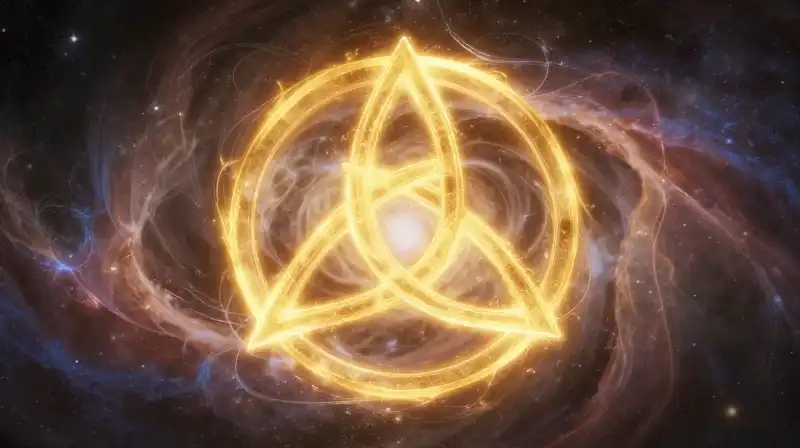
In a world often segmented into “here” and “there,” and “this” and “that,” the triquetra serves as a deliberate reminder of unity. It is a symbol of interconnectedness, represented by three interlocking triangles that form a symmetrical, continuous knot. Far from being a mere decorative motif, the triquetra is a deeply rooted emblem—a visual philosophy that captures the dance between unity and duality across Celtic, Germanic, and Christian traditions.
For those interested in understanding the layers of human heritage, the triquetra offers a window into how ancient cultures have conceptualized existence itself. It is a symbol that transcends simple decoration; it is a living representation of the flow of time, the balance of creation, and the eternal cycles of life, death, and rebirth.
The Three Pillars: Core Concepts of the Triquetra
The power of the triquetra lies in the principle of the trinity—the idea that things are often best understood in sets of three. Within Celtic spirituality, this triplicity is not just a religious grouping, but a comprehensive framework for living. According to 1, the symbol encapsulates the core balance of existence: the union of body, mind, and spirit. This internal harmony is viewed as the fundamental path toward creation.
The triquetra thus speaks to three distinct aspects of human life and divinity. In Celtic lore, the concept is tied to the divine feminine through the Maiden, Mother, and Crone—three stages of womanhood that represent cyclical wisdom and continuous transformation 1. This concept also extends to the fundamental realms of being. Celtic mythology utilized the triquetra to encompass three material domains (earth, sea, and sky) and three spiritual realms (the earth, heaven, and the underworld) 1. The interwoven design, therefore, suggests a perfect flow, where the boundary between the physical and the spiritual is constantly blurred.
A Symbol of Enduring Cycles: History and Variations
The appeal of the three-part balance is universal, making the triquetra an ancient and widespread motif. While its roots are deeply embedded in Celtic thought, the concept of triplicity reached other cultures through shared human understanding of the world’s rhythm. In Christian art, the triquetra was adapted to symbolize the Holy Trinity—the Father, Son, and Holy Spirit—representing unity and co-equality among divine forces 1. This adoption solidified the symbol’s role in articulating ultimate unity.
The triquetra’s ancient reach is also evident in pre-Christian European traditions. Early Germanic tribes utilized triplicities to define their worldviews and the interconnectedness of their existence. Similarly, in Norse mythology, the triquetra is theorized to represent the three main realms of existence: Asgard, Midgard, and Hel 1. These diverse cultural threads demonstrate that the triquetra is a global visual shorthand for the idea that nothing in existence is isolated.
We can observe this enduring cultural resonance in physical structures today. Regional examples, such as the intricate carvings and Celtic Crosses found at Iona Abbey and Melrose Abbey in Scotland, illustrate how the symbol continues to inform and enrich the built environment 1.
Triquetra vs. Trinity Knot: Understanding the Distinction
A common point of confusion for new learners is the difference between a triquetra and a “Trinity Knot.” While they are often used interchangeably in popular culture, they describe slightly different elements. The triquetra is defined specifically by its three interlocking triangles, emphasizing the continuous, rotational motion of unity. Conversely, a Trinity Knot is a broader term often applied to Celtic knots that incorporate three interlocked elements, but the overall geometry or symbolic emphasis may not strictly adhere to the three-pointed triangle motif (1, 2). Simply put, while the triquetra is a specific, potent form of triplicity, the Trinity Knot is a descriptive category for knots featuring three parts.
The Triquetra in Modern Spiritual Practice
Today, the triquetra has transitioned from ancient religious iconography into a powerful spiritual tool for modern seekers. For those with Celtic ancestry, the symbol often serves as a reminder to embrace the interplay of opposing forces—how opposites, when united, can unlock the power of creation 1. It encourages the acceptance of both light and shadow, beginning and ending, all within a single, continuous loop.
In contemporary spiritual contexts, holding a triquetra may be interpreted as a sign during periods of intense spiritual study or personal transformation. It functions as a meditative reminder of the eternal, unending cycle of life 1. Instead of offering a simple answer to questions of fate or morality, the triquetra asks the viewer to contemplate the inherent balance within every challenge and triumph, viewing them not as separate events, but as parts of a single, unified experience.
Understanding the Scope: Is the Triquetra Good or Bad?
Because the triquetra is fundamentally a symbol of unity and interconnectedness, it does not carry inherent moral weight—it is neither “good” nor “bad.” Its meaning is wholly contextual and dependent on the individual or community that employs it. Its power is realized in its capacity to teach the principle of wholeness. It reminds the beholder that, in the grand scheme of things, everything is linked. This concept of cyclical balance allows the symbol to be interpreted across vastly different cultural and philosophical landscapes, from the sacred trinity of organized religion to the natural cycle of the seasons in folklore.
The triquetra remains a magnificent reminder that true understanding often comes not from rigid definition, but from seeing how all things—past, present, and future—flow into one another. It is an invitation to appreciate the beauty in the unending cycle of existence.
References
Footnotes
Frequently Asked Questions
Is Triquetra good or bad?
The triquetra does not carry inherent moral weight because it is fundamentally a symbol of unity and interconnectedness, making it neither good nor bad. Its meaning is wholly contextual and dependent on the individual or community that employs it.
What is the difference between a Triquetra and a Trinity Knot?
The triquetra is specifically defined by its three interlocking triangles and emphasizes the continuous rotational motion of unity. Conversely, a trinity knot is a broader descriptive category for Celtic knots that incorporate three interlocked elements, but which may not strictly adhere to the three-pointed triangle motif.
Related Articles