The Viking Thor: God of Thunder, Protector, and Cultural Icon

Introduction
The figure of Þórr—the Norse god whose name translates from Old Norse as “thunder”—is far more than a simple entry in a mythology textbook. Within the Viking communities and the broader Germanic cultural sphere, Thor embodied the ideal of raw strength, steadfastness, and unwavering protection 1. To a contemporary farmer or a seafaring voyager, he was not just an abstract deity; he was a figure of vital social and physical importance, representing the necessary stability amidst a world of harsh elemental forces. For the peoples of Scandinavia and the Norse diaspora, understanding Thor means exploring a tradition centered on community resilience and the enduring power of the protector, a vital contrast to the more esoteric and cunning nature of the chief god, Odin 1. While many modern interpretations of Thor focus solely on combat and the inevitable fate of Ragnarök, a deeper look at his cultural life reveals his relevance extended to the most practical and domestic aspects of communal survival.
The Protector of the Common Folk
While Odin often captures the imagination with tales of magic and wisdom, the enduring popularity of Þórr lay in his practical, grounded role in the lives of the average Norse person. He was the great protector of those who lived outside the rarefied courts of the elite, a guardian of the hearth, the harvest, and the perilous voyages that formed the backbone of Viking society 1. This protection was not limited to warfare, but extended into the realm of fertility and survival. Farmers sought his favor to ensure bountiful harvests, and those who traveled the open oceans called upon him for safe passage. He was tied directly to the land’s productivity, serving as a deity of vital cultural sustenance 1.
The Symbol of Steadfastness
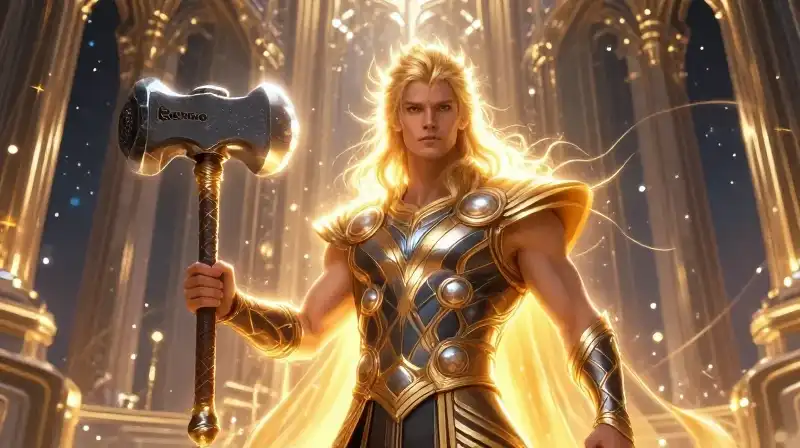
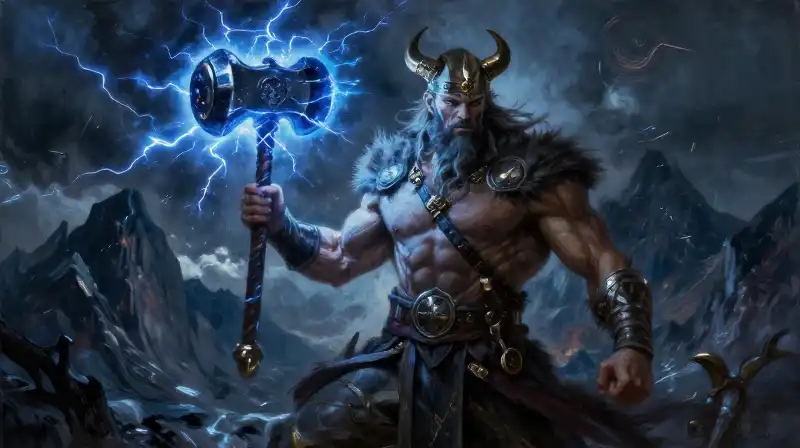
This core belief in his protective power is archaeologically confirmed. Mjölnir, Thor’s hammer, became an exceedingly popular amulet. Its widespread use in Viking graves and at various archaeological sites suggests that the reverence for Thor was a deep-seated cultural practice that persisted long after the cultural shift toward Christianity 1. This hammer functioned as a powerful symbol of divine protection and social continuity, offering a tangible link to the perceived divine strength that safeguarded the Norse community.
Echoes in Modern Life and Language
The impact of this ancient tradition extends beyond folklore; it subtly permeates the cultural landscape of Scandinavia and the wider Germanic world. One of the clearest linguistic echoes of Þórr’s influence is found in the modern English calendar. The weekday we now call Thursday is a direct descendant of Old English terms referencing the “day of Þunor” (1, 2). This linguistic persistence demonstrates how a powerful cultural belief can leave an indelible mark on the everyday fabric of a civilization, even as religious practices evolve.
Names and Cultural Persistence
The significance of Thor is also reflected in the very naming conventions of a people. Among the founding population of Iceland, the tradition is demonstrably strong, with it having been recorded that over a quarter of the population bore names that included Thor’s theonym, such as Thorkill or Thorgest 1. This is more than a historical coincidence; it reflects a community that found cultural continuity and strength by linking their identity to their ancestral deities, even when those gods were being eclipsed by other belief systems (1, 2).
Navigating Myth: Context and Scholarly Debate
For a genuine understanding of the Norse tradition, it is crucial to approach the myths not as literal historical records, but as complex cultural narratives. The early written accounts of the Germanic peoples were compiled by external entities like the Romans, yet later Norse texts, such as the Eddas and Sagas, were compiled centuries after the events they describe. These later texts are fundamentally products of cultural memory and folklore, rather than precise historical documentation (1, 3). Furthermore, modern scholarly study of the Norse pantheon reveals layers of ambiguity.
The Limits of Interpretation
Scholarly debate, based on primary Norse sources, exists regarding the precise attributes of Thor. While he is often popularly viewed as a sky god analogous to Zeus, sources indicate complexity in whether he specifically controlled thunder or the broader weather patterns (2, 3). External comparisons also complicate the picture. Early Roman records demonstrate the phenomenon known as *interpretatio germanica*, a historical process where the Germanic peoples identified Thor with the Greco-Roman god Hercules, likely due to the similarities between his mighty hammer and the club wielded by the Roman deity 1. This highlights the necessity of cultural contextualization, recognizing that assigning specific domains to the Norse gods can sometimes result from the influence of external, non-Norse cultural systems 1.
Addressing Common Myths and Related Search Queries
In the context of understanding Norse traditions, several common misconceptions arise. When asking, “Is there a Greek god called Thor?” the answer is no; while cultural similarities exist (as seen in the identification with Hercules), Thor belongs specifically to the Norse pantheon 1. Similarly, the concept of “who killed Thor” is a central plot point of the mythological cycle. He is destined to face his ultimate adversary, the world serpent Jörmungandr, during the events of Ragnarök (1, 2). Furthermore, the complexity of Thor’s role is often overshadowed by modern media, such as Marvel, where he is portrayed as a superhero, simplifying a nuanced spiritual figure into a generic combat role. This comparison fails to capture the original tradition of steadfast protective deity.
Synthesis: The Enduring Power of a Guardian
The tradition of Thor, therefore, is a profound study in cultural persistence. His significance moved seamlessly from a practical agrarian god to a revered figure in personal naming and powerful cultural symbols. Whether viewed as a formidable warrior battling monstrous foes or as the dependable guarantor of good fortune and safe harbor, Þórr represents the archetype of the powerful protector. His journey is not merely a sequence of myths, but a narrative of a community finding stability and meaning in a challenging world, and his linguistic and cultural echoes demonstrate that his influence continues to resonate far beyond the ancient sagas.
References
Footnotes
Frequently Asked Questions
Is there a Greek god called Thor?
No, there is no Greek god called Thor; Thor is specifically a deity of the Norse pantheon. While early Roman records show that the Germanic peoples identified Thor with the Greco-Roman god Hercules, he is not Greek.
Related Articles