The Ironwood (Járnviðr) in Norse Mythology: Origins and Lore

Introduction
The mythology of the Norse people is a tapestry woven from human stories and the immense, wild forces of the natural world. Within this cosmic map, few places are as potent in their evocative imagery as Járnviðr, often translated as “Iron-wood.” More than just a geographical location, Járnviðr represents a powerful boundary—a wilderness of immense, often terrifying power that exists beyond the boundaries of human civilization (Midgard). It is the seat of primeval forces, populated by giantesses and wolves, serving as a living record of the untamed aspects of Norse cosmology. Understanding the Ironwood is not simply learning a definition; it is examining a key part of how early Scandinavian cultures framed the relationship between human civilization and the limitless power of the forces they believed governed the world.
The Untamed Edge of the World
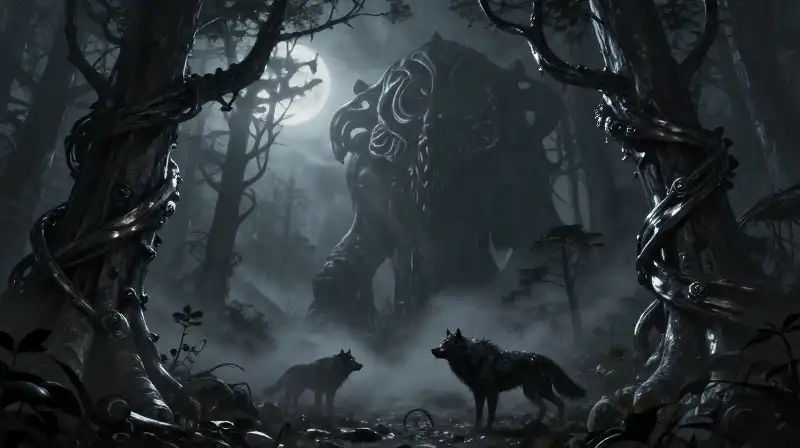
Located far to the east of the human realm, Járnviðr is not a familiar forest of timber and underbrush. Its name, “Iron-wood,” speaks to a materiality beyond the ordinary, suggesting a place of ancient power and geological immensity [1]. As a location, it functions as a realm of extreme wilderness. According to records detailing this mythological landscape, the Ironwood is a massive, untamed expanse that exists just at the edge of the known world [2]. While most human activity is understood to occur within Midgard, Járnviðr embodies the primordial chaos. This is a space where the rules of human society do not apply, serving as a habitat for some of the fiercest creatures in the Norse mythos: witches, colossal wolves, and powerful troll-women [2, 3]. For a community looking at this world through a spiritual lens, the Ironwood represents the places that remain un-civilized, the untamed spaces that hold immense, unpredictable power.
The Progenitors: Life within the Ironwood
The denizens of Járnviðr are as monumental as the forest itself. Among the most significant figures are the *járnviðjur*, or “ironwood-women.” These figures are depicted not merely as inhabitants, but as foundational elements of the Norse world’s monstrous population [1, 3]. These women possess a powerful role as progenitors. The Eddas describe the *járnviðjur* as bearing the various *jötnar* (giants) and enormous wolves found within their region [1, 3]. This establishes the Ironwood not just as a backdrop for monsters, but as the breeding ground and spiritual source of some of the most powerful and destructive creatures in the Norse pantheon. It is important to note that historical texts record the term in singular forms as well, referring to a specific figure known as the *Járnviðjur* among the multitude of troll-wives 1. These figures embody an ancient, powerful lineage, nurturing the monstrous offspring that eventually shape the fate of the gods and men [3].
The Shadow of Fate: Wolves and Ragnarök
The presence of giant wolves is perhaps the most dramatic aspect of Járnviðr’s lore. The Ironwood is the cradle of beasts that are prophesied to play a critical, often catastrophic, role in the twilight of the world, Ragnarök. Among these legendary creatures is Mánagarmr, a mighty wolf born of the Ironwood’s lineage, also known by the name Hati [2, 3]. Mánagarmr’s destiny is tied to the very celestial events of the end of the world: he is prophesied to swallow the moon during the chaotic events of Ragnarök [2, 3]. This ties the elemental, untamed power of the Ironwood directly to the great cycles of Norse time and destruction. The forest thus represents the confluence of raw, natural power (the Iron-wood itself) and the unstoppable forces of cosmic change, symbolized by the wolves that spring from its depths.
Járnviðr in the Literary Tradition
The importance of Járnviðr has been reflected across multiple layers of Norse textual tradition. The mythological basis of the forest is first attested in the *Poetic Edda*, specifically within the powerful poem *Völuspá* [1]. Snorri Sturluson later expanded upon these myths, providing further elaborations and traditions of the Ironwood and its inhabitants in his *Gylfaginning* [1, 3]. For a deeper understanding of the cultural context, scholars have examined the legend through other narrative forms. The mention of the forest and its inhabitants in historical Icelandic texts, such as the *þulur* and the skaldic poem *Háleygjatal*, shows that the legend of the wild region permeated the regional storytelling and poetic traditions of the people [1].
Understanding the Meaning of the Ironwood
For a reader seeking to grasp the essence of Járnviðr, the traditional interpretation moves beyond a simple monster hunting ground. It functions as a cultural anchor for the concept of the *untamed supernatural space* [2]. It is the place where the natural, untamed, and monstrous aspects of existence meet. When people ask, “What is the famous forest in Norse mythology?” the answer is not just a list of facts, but the cultural realization that the world is not wholly governed by order. Járnviðr is the manifestation of cosmic duality—it is the fierce, magical, and terrifying counterpoint to the organized worlds of Midgard and Asgard. The tradition of the Ironwood teaches a deep respect for boundaries: the boundary between civilization and wilderness, the boundary between life and primordial force, and ultimately, the boundary leading toward the ultimate end of days. In contemporary studies of Norse folklore, the study of places like Járnviðr serves as a reminder that the heritage of these communities is as complex as their monsters. It grounds the reader in a world where the wild is not merely a setting, but an active, powerful, and essential force shaping destiny.
References
Footnotes
Frequently Asked Questions
What is the famous forest in Norse mythology?
Járnviðr, translated as Iron-wood, is a massive, untamed wilderness located beyond the boundaries of human civilization (Midgard). It is described as a powerful boundary and a seat of primeval forces, representing the untamed and chaotic aspects of Norse cosmology.
Related Articles