Humanoid Fantasy: A Global Guide to Myth’s Most Diverse Beings

Introduction
The concept of the humanoid—the figure that walks the boundary between the ordinary and the extraordinary—has served as one of humanity’s most profound cultural lenses. To ask “what are the five main humanoid races?” suggests a need for a universal taxonomy, but across global traditions, the “humanoid” is not a fixed category. Instead, it is a reflection of a community’s deepest spiritual concerns: the fear of the unseen, the longing for divine power, and the understanding of life’s transformative cycles. These beings are not merely fantastical creatures; they are living archetypes that hold cultural weight. Whether they are benevolent guides, destructive forces, or sacred catalysts, humanoid figures in folklore reveal how different people perceive the relationship between nature, divinity, and human mortality.
The Mimic and the Magnificent: Shapeshifters and the Liminal
Perhaps the most striking feature of global humanoid myths is the fluid boundary between man and other. Shapeshifters serve as powerful metaphors for transition and transformation—a constant reminder that the self is not static. In the Gullah Geechee tradition, the Boo Hag embodies this transformation, functioning as a shapeshifting witch who preys on human lifeforce, integrating ancient European beliefs about the Night Mare 1. This motif of boundary-crossing is echoed in South America by the Encantado, Amazon river dolphins rumored to take human form, blurring the line between river spirit and person. This cultural preoccupation with form is also seen in the indigenous Siouan tradition, where the Buffalo People are described as a primordial race of shapeshifting witches whose intermarriage with the gods is credited with creating early humans (2, 1). For the West African tradition, this duality is represented by figures like Mami Wata and the Jengu, described as beautiful, mermaid–like water-dwelling humanoids 1. These beings do not merely live outside of humanity; they actively occupy the places where humanity intersects with the environment, demanding respect for the wild and the liminal spaces.
Mediators and Architects: Beings of Spiritual Power
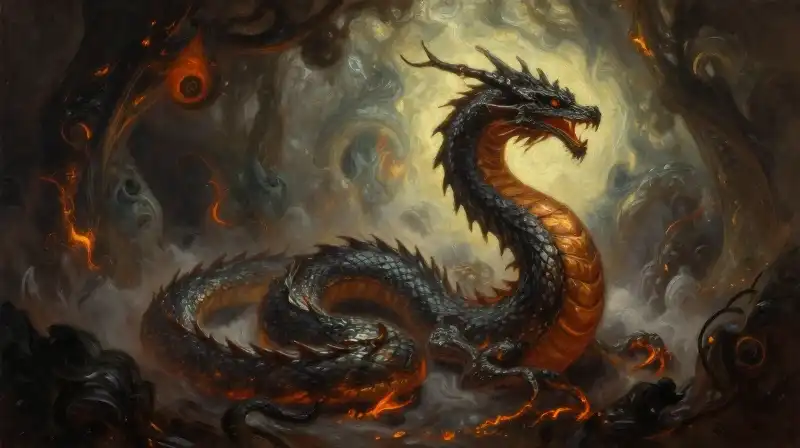
Not all mythological humanoids are chaotic; some exist to bridge the gap between worlds, providing guidance or enacting divine cycles. In the Lakota tradition, the Heyoka are not typical spirits; they are chosen medicine men who wield supernatural abilities and possess a unique ability to move between realities, often appearing in ways that defy conventional expectation 1. Elsewhere, the Gvelisperi (Snakelike) is a powerful example of a being bound by divine purpose. This creature can shapeshift into human form and is intrinsically tied to the concept of being rewarded for service or devotion to a specific divine power 1. Even concepts within Hinduism contain figures like the Gandharvas, which serve as an analogue to elves, illustrating how these beings can embody aesthetic, celestial, or protective forces within a spiritual framework 1.
The Chthonic and the Corrupt: Destructive and Transformative Energies
The mythological record is also rich with beings that represent the darker, more complex pressures of existence—those forces that cause suffering or drive change. In Aztec cosmology, the Tzitzimitl were female demons whose significance lay in the cycles of destruction, acting as the prophesied agents of the world’s end and being specifically observed during eclipses 1. Their existence represents a powerful acknowledgement of cosmic cycles and inherent danger. This theme of destructive lineage is seen in the Igbo folklore of Ogbanje, a spirit who repeatedly re-incarnates into the same family only to die young on purpose. This cycle was historically believed to be a deliberate mechanism designed to drive the living family into profound grief 1. In Navajo belief, the Chindi is a dark manifestation of the soul; it is a spirit that may separate from the body upon death and remain behind as a localized shadow of despair 1. These figures are often understood not as “evil” in a modern sense, but as forces of consequence and transformation.
Negotiating the Natural World: Spirits of Landscape and Community
Many of the world’s humanoid entities are intrinsically tied to specific geographical features and cultural needs. For the Pacific Northwest peoples, the lore includes Asin, an ogre-like monster associated with the predatory act of capturing children, and the Little People, a category that encompasses beings from diminutive fairies to large, hairy figures 1. These entities serve to reinforce local boundaries and the necessary caution required when venturing into unknown or sacred spaces. In the North American Algonquian tradition, the Mesingw provides a compelling example of ritualistic concealment and identity; this hairy dwarf wears a wooden mask to hide a deformed face while riding a white stag 1. Similarly, the Inuit tradition features the Tariaksuq, anthropomorphic caribou people believed to inhabit a parallel universe. A unique characteristic of this belief is that the beings themselves are unseen, yet their shadows can be perceived in our world, a subtle metaphor for the thin veil separating realities 1.
The Utility of Myth: Understanding the Living Culture
To move beyond simple classification, it is useful to examine the practical ways these myths function. Entities like the Batonebi, found in various folk traditions, represent invisible spirits capable of bringing specific diseases. However, their presence is also mitigated by human action; they can be appeased by simple human cheer and sweets, suggesting that the maintenance of communal goodwill is a practical defense against supernatural affliction 1. This approach—understanding the “how” and “why”—is vital because the humanoid is rarely a monolith. Traditions like the Nephilim, described in biblical texts as half-angel giants born from union between celestial and human beings 1, serve a function of explaining massive, chaotic historical events. Conversely, figures like Samdzimari in non-Western folklore present a more nuanced narrative: a female spirit who seduces men and potentially represents divine inspiration, eventually transforming into an animal to find a new mate 1. Ultimately, the variety of humanoid figures globally—ranging from the manipulative Chindi to the benevolent Gandharvas—offers a comprehensive map of human consciousness. They teach communities about respecting natural limits, the consequences of imbalance, and the fluid nature of existence. They are not objects of curiosity, but anchors for tradition, grounding complex spiritual ideas in relatable forms.
References
Footnotes
Frequently Asked Questions
What are the five main humanoid races?
The article does not specify five main humanoid races, stating that the humanoid is not a fixed category but rather a reflection of a community’s spiritual concerns. Instead, it provides various examples of shapeshifters, mediators, destructive figures, and spirits of the landscape found across different global traditions.
Related Articles