Cernunnos: Decoding the Celtic Horned God of the Wild

Introduction
Cernunnos is a powerful and multifaceted figure within the tapestry of European heritage—an archetype of wildness, fertility, and the untamed spirit of the ancient forest. Often described simply as the “Celtic Horned God,” the figure found in Gaul and across neighboring lands represents a profound connection between the spiritual realm and the cyclical, primal forces of nature. For those who study these ancient traditions, understanding Cernunnos requires looking past the simple image of an antlered man and delving into the deep cultural significance of the untamed wild. He is not merely a mythical figure; he is a symbol of the seasonal turning, the inherent duality of life, and the sacred pulse of the land.
The documentation of Cernunnos is rare but potent. His name appears most clearly only once, on the 1st-century CE Pillar of the Boatmen from Paris, where he is depicted as an aged, antlered man. However, his presence is widely attested in various iconographic clusters, including those found in north-eastern Gaul, and in geographically distant outliers such as the Gundestrup cauldron in Denmark and Val Camonica in Italy 1. This scattered presence suggests a wide, influential cultural reach for this ancient divinity.
The Archetype: Decoding the Horned Icon
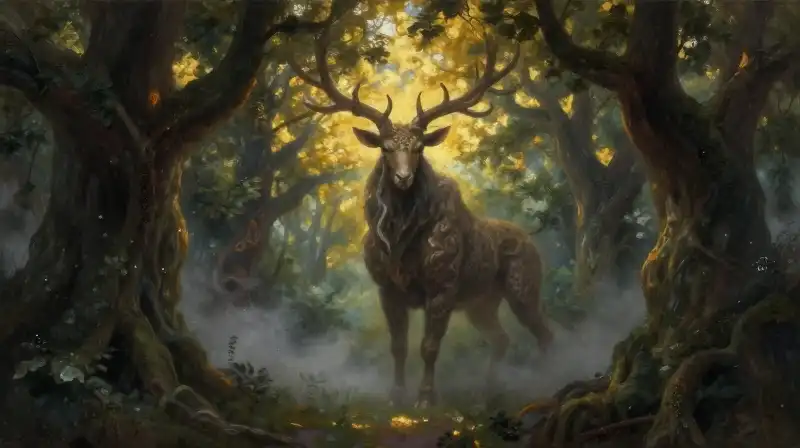
Iconography serves as the primary window into how ancient communities visualized their deities. The typical representation of Cernunnos is highly specific, often depicting a male figure with crossed legs, crowned by impressive antlers (1, 2). He is frequently shown holding symbols of vital energy and the natural world, such as a ram-horned serpent or a torc, which itself symbolizes fertility and the power of the wild (1, 2).
Scholars have debated the etymology of the name, with theories suggesting it might derive from proto-Indo-European roots meaning “horn” or “angle,” or perhaps from the Old Irish word for “hero” 1. Regardless of the precise linguistic origin, the visual language of the figure—the blend of human, animal, and divine traits—is what anchors his meaning. He embodies a powerful, composite energy that links the forces of nature in a single, formidable presence.
Meaning and Symbolism: The Wild God’s Cycles
The figure of Cernunnos is not singular in meaning, but rather serves as a repository for various powerful concepts regarding life and death, growth and decay. Archaeological interpretation has long placed him in complex roles, suggesting he may have been seen as a god of the underworld or associated with bi-directionality 1. This interpretation points to a deity whose power transcends the simple boundaries of life, embracing the complete cycle of existence.
Modern mystical and esoteric readings have refined this image, portraying Cernunnos as the “Untamed Horned God of the Animals” and the “Green Man.” In this context, he is fundamentally linked to the regenerative power of nature and the natural cycles of growth and dormancy 1. This view sees him as a creature of the sacred forest, embodying the transformative cycle of seasonal life. He is seen as the powerful Dark One during the winter’s deepest cold, eventually giving way to the vibrant Green Man in the height of summer 1.
Regional Nuance: Navigating Cernunnos and Irish Lore
A critical component of truly understanding this tradition is recognizing its regional boundaries. Although the concept of horned gods resonates throughout European mythology, scholarly research maintains that Cernunnos is primarily a figure of Gaulish folklore and is not inherently a deity of Irish Paganism 1. Attempts to find an exact parallel in Irish lore yield figures that are related by motif but fundamentally different in status. For instance, stories within the Fenian Cycle mention nature-connected men, but these figures are described as mortals, not gods 1.
The Irish concept of a “horned man” takes a different shape through the figure of An Dagda, which translates to “man of the peak or pinnacles.” This linguistic variation and the clear distinction in divine status highlight how the powerful archetype of the horned figure evolved and manifested differently across distinct cultural landscapes 1. This comparison illustrates the danger of applying one mythological lens universally, demonstrating the importance of regional specificity when exploring world heritage.
The Living Tradition: A Path of Communion
In contemporary spiritual practice, Cernunnos’s significance remains rooted in the immediate, sensory experience of the earth. The path of communion with Cernunnos demands more than abstract devotion; it calls for a genuine immersion in the “Wild Wood” 1. This spiritual journey requires the seeker to prioritize instinct over the rational mind, seeking a direct, visceral connection to the land 1. His energy is often compared to the wild, vital, and occasionally dangerous erotic force of the Greek Satyr Pan, reflecting the raw, unbridled vitality inherent in the Horned God 1.
Ultimately, Cernunnos serves as a perennial reminder that true knowledge comes not from books or scrolls, but from the cycles of the environment. He represents the necessary wildness that exists outside of human control—the element that insists on being honored, observed, and understood through the lens of natural rhythm.
Synthesis: Respecting the Wild Essence
When we decode the figure of Cernunnos, we are engaged in understanding a powerful ecological and spiritual philosophy. He teaches that to live in tune with the natural world, one must accept duality: the life and the dormancy, the man and the beast, the cultivated and the untamed. Whether seen through the lens of ancient Gaulish iconography or modern practice, the figure persists as a symbol of resilience and primal power. The enduring relevance of this archetype lies in its persistent demand that humanity acknowledge the vital, sacred forces residing in the unmanaged wilderness.
References
Footnotes
Frequently Asked Questions
Who is the mythical god with horns?
Cernunnos is frequently referred to as the Celtic Horned God and is typically depicted as a male figure crowned by impressive antlers. He is also associated with the Irish figure An Dagda, who is described as a horned man.
Related Articles