What the Cross Symbolizes in Day of the Dead Ofrendas

Introduction
The Day of the Dead (*Día de Muertos*) is not simply a commemoration of the deceased; it is a vibrant cultural observance that actively facilitates the homecoming of spirits. At the heart of this process lies the *ofrenda*—an elaborate altar—which functions as a spiritual map, a festive gateway between the world of the living and the realm of the departed. While the *ofrenda* is a mosaic of symbols—from *Pan de Muerto* to the fluttering guidance of Monarch butterflies—the cross stands as one of its most intentional, foundational elements. The cross in these altars serves a profoundly practical and spiritual purpose: it is a directional marker, strategically placed to help ancestral spirits navigate the journey back to their families.
The Cartography of the Spirit: Directing the Way Home
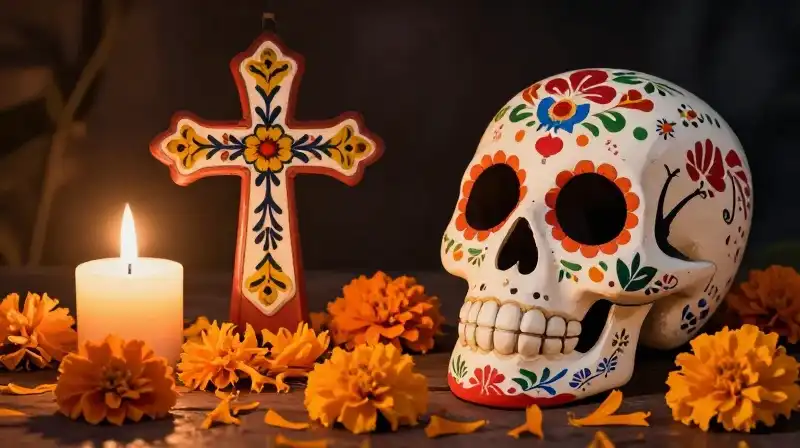
Within the intricate architecture of the *ofrenda*, candles are often arranged in the distinct shape of a cross. This symbol is not merely aesthetic; its placement is a precise navigational aid. According to foundational traditions, the cross explicitly represents the cardinal directions of the world—North, South, East, and West 1. For the returning spirits, these candles act as illuminated markers to orient their journey and pinpoint the exact location of their ancestral homes. In a tradition built on the idea of the spiritual reunion, this orientation is critical. The cross thus transforms the *ofrenda* into a spiritual compass, ensuring that the spirits can successfully traverse the realms to be welcomed by their living kin.
The Structural Meaning: Hierarchy and Guidance
>The placement of the directional cross is contextualized within the broader structure of the altar itself. While every *ofrenda* is a unique expression of family memory, regional variations dictate the complexity and layout of the spiritual space. Some traditions present a flat surface, but more complex arrangements often ascend in tiers, a common feature of the observance. These levels—ranging from the customary three tiers to up to seven—are symbolic representations of the spiritual hierarchy: heaven, earth, and the underworld 1. The placement of the cross, therefore, reinforces this cosmological map, providing both the directional coordinates and the metaphysical framework that guides the soul through its journey back to the earth.
A Multilayered Ecology of Guidance
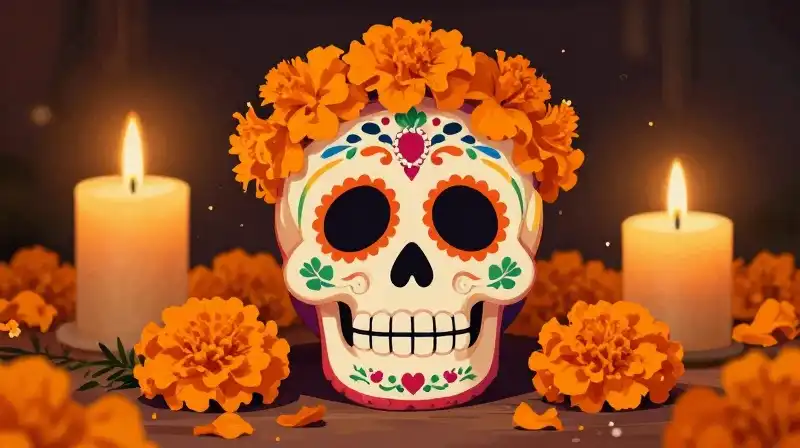
>The directional cross works in concert with a multitude of other elements designed to attract, guide, and welcome spirits. The sensory experience of the *ofrenda* is designed to be holistic. *Cempasúchitl*, the “Flor de Muerto,” plays a multifaceted role in this guidance system; its distinctive pungent scent is believed to attract the spirits, while its vibrant oranges and purples are thought to guide the souls and evoke a sense of joy and peaceful remembrance 1. Complementary to these botanical guides are ancestral practices like the burning of copal incense. This fragrant resin is used to symbolize the transformation from the physical plane to the supernatural, with the smoke serving to purify the environment and carry the prayers of the living directly to the heavens for the returning spirits 1.
Indigenous Roots and Cultural Blending
>The tradition of the directional cross, while deeply entrenched in the modern observance, reflects a complex history of cultural evolution. The concept of spirit guidance has ancient roots in Mesoamerican traditions, most notably the figure of the *Xoloitzcuintli*. This ceramic or sculpted figure, representing the ancient native dog, symbolized the faithful guide that traversed the Chiconauhuapan river, leading spirits into the underworld 1. This indigenous emphasis on guide spirits—now blended with the European concept of the directional cross—underscores the living nature of the tradition. Furthermore, the *ofrenda* is often a site of cultural syncretism; elements like the playful *tapetes de arena* (sand sculptures) draw influence from European Catholic festivities such as Corpus Christi, eventually integrating into the indigenous Day of the Dead framework 1.
The Living Memory: More Than Just an Offering
>The presence of the cross, candles, and flowers represents far more than merely following old rules; it reflects the enduring human commitment to memory and continuity. The *ofrenda* as a whole serves as a bridge where the historical past (represented by the *Xoloitzcuintli* and *La Catrina*, a figure originally created as social commentary by José Guadalupe Posada) meets the present. Small figures known as “Angelitos” specifically represent the children who have passed, ensuring that the remembrance is inclusive of all ages and types of loss 1. Ultimately, the directional cross is a quiet, intentional act of love and memory—a visible promise that for the duration of the observance, the distance between the living and the dead is bridged by light, direction, and profound respect.
References
Footnotes
Frequently Asked Questions
What does the cross mean in Día de los Muertos?
The cross serves as a directional marker and navigational aid, explicitly representing the cardinal directions of the world—North, South, East, and West. It is strategically placed to help ancestral spirits orient their journey and pinpoint the exact location of their ancestral homes.
Do ofrendas have crosses?
The cross is considered one of the most intentional and foundational elements of the ofrenda. Within these altars, candles are often arranged in the distinct shape of a cross, acting as a directional marker to help ancestral spirits navigate their journey home.
What are the rules of an ofrenda?
The core of the ofrenda is a directional cross, often made of candles, strategically placed to represent cardinal directions and guide ancestral spirits home. These altars may also feature tiered structures to symbolize spiritual hierarchy, and utilize elements like cempasúchil flowers and copal incense for guidance and purification.
Related Articles